
Several things hold up a livestock business, and a silage baler is one of the more underrated among them. Feeding is the factor that decides whether a farm succeeds, and how a farmer secures that feed sits at the centre of everything else.
The animal determines the feed. Each species has its own requirements, and within a species those requirements shift with age and stage of production. But every operation faces one problem in common, and it is seasonal.
Feed Quality Decides the Outcome
There is a widespread belief that genetics is the real secret behind a successful herd. Genetics matters, certainly, but an animal is a living creature, and good genetics returns nothing without the nutrition to support it. An animal can fail, and in serious cases die, simply from being fed the wrong ration. If you have invested in good stock and then pay little attention to the feed, that investment is largely wasted.
The right portion with the right nutrients brings out what the animal is capable of, and makes the targets you set far easier to reach.
Consistency is the second half of the equation, and it is the half that gets neglected. Feeding high-quality material occasionally changes very little. What moves production is feeding it reliably, day after day, because an animal’s body responds to sustained nutrition rather than to good intentions applied now and then.
What Happens When the Dry Season Arrives
This is where consistency becomes difficult, and it is the problem silage exists to solve.
In tropical regions, and equally in the summer of temperate ones, forage quality collapses when rainfall stops. Plants that do not receive enough water decline in protein, mineral content, and energy. The pasture may still look like pasture, but what the animal is actually eating is a considerably poorer feed than the same field offered three months earlier.
The consequences follow a predictable sequence. Intake of nutrients falls below what the animal needs for growth. Condition deteriorates. Animals become more prone to illness. Fertility drops, which hits the following year’s production before you have finished dealing with this year’s. For a commercial operation, a bad dry season is not simply an uncomfortable few months. It threatens the business.
In the wet season the opposite is true. Plants are at peak growth and nutrition is abundant enough that a farmer can be relatively casual about ration composition and still get acceptable results. That abundance is precisely the opportunity. The material that is surplus in the wet season is exactly what is missing later.
The traditional answer was to gather forage as it was needed. That works only where plants grow abundantly and consistently year round, which realistically means a farm sitting in or beside forest. For any operation of commercial size, it is not a workable model.
What Cattle Actually Need
If the goal is to preserve nutrition rather than just bulk, it helps to be clear about what you are preserving. Cattle are ruminants, and their nutrition works differently from ours in ways that matter here.
| Nutrient | Why It Matters |
|---|---|
| Water | The nutrient most often overlooked, and the one animals need in the largest quantity every day |
| Energy from carbohydrates | Fibre and starch are fermented by rumen microbes into volatile fatty acids, which supply most of the animal’s energy |
| Protein | Feeds both the rumen microbes and the animal itself, supporting growth, milk, and reproduction |
| Fat | An energy-dense component, but kept to a modest share of the diet since excess disrupts fibre digestion in the rumen |
| Minerals | Needed in small amounts but essential for bone development, cell function, and fertility |
| Vitamins | Support growth, immunity, and production, with some B vitamins produced by the rumen microbes themselves |
Two points are worth drawing out, because they are commonly misunderstood.
Carbohydrates do not work in a ruminant the way they work in a human. Rather than being absorbed and burned directly, fibre and starch are fermented by the microbial population in the rumen, and it is the products of that fermentation that the animal actually lives on. This is why a ration needs adequate physical fibre and not simply calories, and why feed that has been reduced to fine particles causes problems.
Fat is useful but not straightforward. It carries more energy per kilogram than anything else in the ration, which makes it tempting, yet too much fat interferes with the microbes breaking down fibre. It belongs in the diet in a controlled amount rather than as something to maximise.
Protein and water, meanwhile, are the two most likely to be quietly short in a dry season ration, and they are the two most often missing from feed discussions entirely.
Preservation Is the Mechanism, Not a Nutrient
Preservation does not add anything to forage. What it does is stop the loss.
The logic is straightforward once stated. Plants carry their highest nutritional value at a particular growth stage, and harvesting at that stage captures it. Ensiling then seals the material so that the value captured at cutting is still there months later, rather than declining in a field or a shed. You are not improving the feed. You are refusing to let the calendar take it away.
That is why a silage baler matters for the seasonal problem. It lets you move nutrition through time, from the month when forage is abundant into the month when it is not.
Getting the Timing Right
Since preservation locks in whatever quality exists at cutting, the cutting decision carries more weight than any later step.
Forage quality and yield move in opposite directions as a crop matures. Cut early and you get better feed but less of it. Cut late and you get more tonnage of poorer material. Waiting also raises silica content, which makes the crop more abrasive and dulls machine blades faster, so a late cut costs you twice.
Moisture matters just as much, since ensiling depends on fermentation happening under the right conditions, and material that is too dry will not compact or ferment properly.
The practical conclusion is that a silage operation is planned around the crop rather than around the machinery calendar. The machine should be ready when the crop is, not the other way round.
Jummos, Feed Machinery Manufacturer
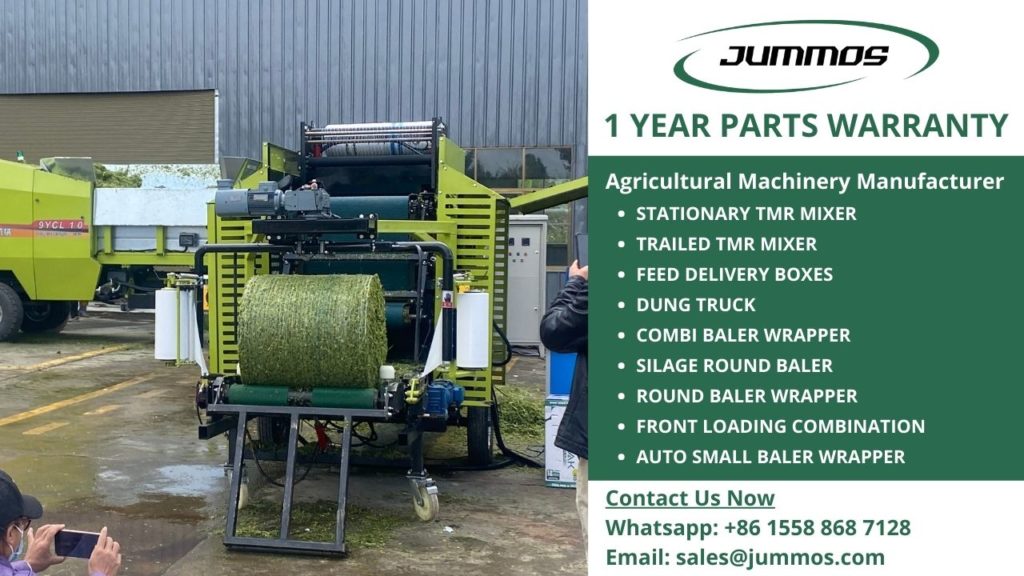
Jummos builds machinery for exactly this part of the farming year. We manufacture baler wrappers that bale and seal forage in a single pass, trailed and stationary TMR mixers for feeding that preserved forage as a balanced ration, feed spreader trucks, and manure cleaning trucks, from our factory in Qingdao, China.
Our sister brand Silopak produces the silage film and net wrap that go with the machines, so the equipment and the consumables are matched rather than assembled from different suppliers. We hold SGS audited supplier status and ship worldwide with full export documentation, and every machine carries a one-year parts guarantee.
Tell us your herd size, your forage, and how long your dry season runs, and we will help you work out what you need to carry your animals through it.
Frequently Asked Questions
Why does forage quality drop in the dry season?
Plants that do not receive enough water decline in protein, mineral content, and energy, so the same pasture that fed the herd well in the wet season delivers considerably less nutrition later. The field may still look green enough to graze, which is part of the problem, because the decline in feed value is not obvious by eye. The effects show up as reduced growth, poorer body condition, higher susceptibility to illness, and lower fertility, which carries the problem into the following year.
Does making silage improve the feed?
No, and that is worth being clear about. Ensiling preserves the nutritional value the crop had at the moment it was cut. It does not add anything. This is why the timing of the harvest matters more than anything that happens afterwards: if you cut late and preserve poor forage, you have successfully stored poor forage. Cut at the right growth stage and seal it properly, and you are feeding in January what the field offered in June.
What nutrients do cattle need from preserved forage?
Water, energy, protein, a controlled amount of fat, minerals, and vitamins. Energy in a ruminant comes largely from rumen microbes fermenting fibre and starch into volatile fatty acids, so adequate physical fibre matters as much as total calories. Protein feeds both the microbes and the animal. Fat is energy dense but kept to a modest share, since too much interferes with fibre digestion. Protein is often the nutrient most short in dry season forage.
When should forage be cut for silage?
Earlier than instinct usually suggests. Quality and yield move in opposite directions as a crop matures, so waiting gives more tonnage of poorer feed. Later cutting also raises the silica content of the crop, which makes it more abrasive and shortens the life of your machine blades. Moisture matters too, since fermentation needs the right conditions and overly dry material will not compact or ensile properly. Plan the operation around the crop rather than around machine availability.
Reviewed by Sue Su, Marketing Director of Jummos, on September 18, 2026. Ruminant nutrition and forage timing guidance was checked against current animal nutrition references to keep the information accurate for farmers.