
Dairy Dung Cleaner: Choosing a Manure Removal Method That Fits Your Barn
A lactating dairy cow produces somewhere between 45 and 70 kilograms of manure and urine every single day, which works out at roughly seven to eight percent of her body weight. Fifty cows therefore generate something close to two and a half tonnes a day, and it does not stop when you are busy. The real question on a dairy farm is almost never whether to clean. It is which method moves that volume out of the shed fast enough to protect udder health and feet, at a labour cost you can live with for the next ten years. A dairy dung cleaner is one answer among several, and the right one depends far more on how your cows are housed than on which machine looks most impressive in a brochure.
Start With the Housing, Not the Machine
Manure behaves differently depending on what it lands on and what it gets mixed with. In a bedded loose house, manure combines with straw or sawdust and becomes a solid you can lift with a bucket. On a scraped concrete alley in a cubicle shed, it stays a thick slurry you can push. On a slatted floor it drops through into a tank below and becomes a liquid you have to pump and agitate. Each of those three states needs completely different equipment, and buying for the wrong state is the most common and most expensive mistake in this part of the farm.
That is why the sequence matters. Decide the housing and bedding system first, then the manure state follows, then the handling method, and only then the machine. Farms that do it in reverse end up with a vacuum tanker parked next to a bedded pack it cannot lift, or an alley scraper installed in a shed whose floors were never laid to a usable fall. Neither piece of equipment is at fault in those cases.
| Housing type | Manure state | Methods that suit it | Methods that do not |
|---|---|---|---|
| Tie stall or stanchion | Solid to semi-solid, mixed with bedding | Gutter cleaner chain, barn cleaner elevator, hand scraping to a cross channel | Flush systems, which need open alleys |
| Free stall or cubicle, solid floor | Thick slurry | Automatic alley scraper, tractor scraper blade, vacuum tanker collection, flushing in warm climates | Bucket loading, which is too slow for daily passes |
| Free stall, slatted floor | Liquid slurry in an under-floor store | Slurry pump and agitator, tanker spreading, separator | Scrapers and solid handling equipment |
| Bedded pack or deep litter | Solid, high carbon | Loader bucket, muck spreader, composting in windrows | Slurry pumps, which cannot handle the fibre |
| Open yard, feed pad, collecting area | Semi-liquid, often rain diluted | Vacuum tanker or dung truck, tractor scraper, sump and pump | Fixed alley scrapers, which do not suit variable traffic areas |
Why Cleaning Frequency Decides Cow Health
The argument for frequent removal is not tidiness. Environmental mastitis pathogens, among them E. coli, Klebsiella and Streptococcus uberis, live in manure and reach the udder from contaminated bedding and standing surfaces. A cow lying in a stall whose rear third is soiled is being presented with those organisms at teat level for ten or more hours a day. Contagious mastitis spreads cow to cow through milking, but environmental mastitis is a housing and hygiene problem, which means it is something the cleaning routine can genuinely change.
Foot health follows the same pattern. Digital dermatitis, often called hairy heel wart, is associated with Treponema organisms and is consistently worse where cows stand in wet manure for long periods. Standing in slurry softens the hoof horn and lets bacteria into the skin at the heel bulb and the interdigital space. Farms that move from one scrape a day to four or more passes usually report fewer new lesions, and footbathing works considerably better when the feet going into it are not already caked.
Then there is the fly cycle, which is the easiest win available. A house fly can complete the journey from egg to adult in roughly seven to ten days in warm weather, and faster still at the top of that temperature range. If manure and soiled bedding sit undisturbed for longer than that interval, you are effectively running a breeding facility. Removing or disturbing the substrate inside the cycle breaks reproduction without any chemical at all. One correction worth making here, because the point is often stated loosely: house flies do not bite. They carry pathogens on their bodies and irritate cattle around the eyes and muzzle. The biting fly in a dairy shed is usually the stable fly, Stomoxys calcitrans, and it breeds in much the same wet organic material.
Ammonia is the fourth reason and the one that affects the people as much as the cows. Urea in urine is broken down into ammonia by urease enzymes present in faeces, which means ammonia is produced mainly where urine and faeces sit together on a floor surface. Removing the mixture promptly, rather than letting it pool and dry, is the single most effective way to lower the ammonia load in the air your staff breathe during milking.
The Five Methods, Honestly Compared
There is no best system in general, only a best system for a given shed, climate, labour market and manure store. What follows is what each method actually does well and where it disappoints, written from the perspective of a farm that has to live with the choice rather than sell it.
| Method | Strengths | Weaknesses | Fits best when |
|---|---|---|---|
| Hand scraping | No capital cost, works anywhere, no breakdowns | Labour intensive, quality drops when staff are tired or short | Small herds, tie stalls, or as a finishing pass behind machines |
| Tractor scraper blade | Uses a tractor you already own, flexible across yards and alleys | Needs an operator every pass, cows must be moved, fuel and tyre cost | Mid-size herds with a tractor already in daily use |
| Automatic alley scraper | Runs many passes a day unattended, very consistent, cows adapt to it | Needs flat true floors and a reception channel, chain or cable maintenance | Purpose built cubicle sheds with solid alleys and a slurry store |
| Flush system | Extremely fast, excellent floor hygiene, low daily labour | Large water volumes, recycling and settling infrastructure, freezing risk | Warm climates with water available and a lagoon system in place |
| Vacuum tanker or dung truck | No fixed installation, collects and transports in one operation, moves between areas | Operator time per load, suction suits semi-liquid better than fibrous packs | Farms with yards, feed pads and scattered collecting areas, or no slurry channel |
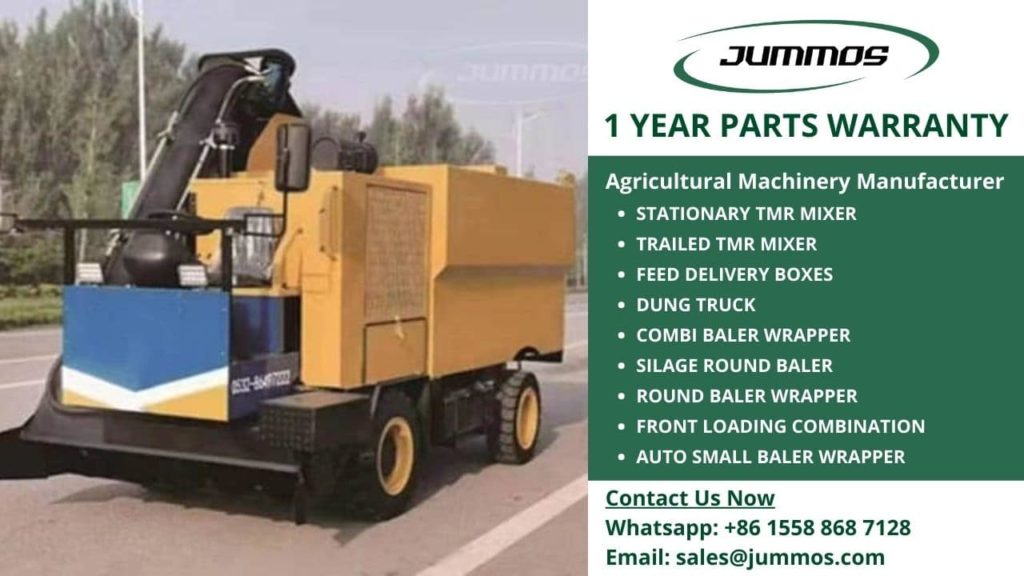
The vacuum approach deserves a note because it is the one most often misunderstood. A machine of this type lifts and carries in one movement, which removes the double handling that makes tractor scraping slow on a spread out farm. It is strongest on semi-liquid material from concrete yards, collecting areas and feed pads. It is weakest on a deep bedded pack with long straw, because fibre of that length does not travel through a suction line well. If your manure is mostly straw, a loader and a muck spreader will serve you better, and that is worth knowing before rather than after. Jummos builds equipment in this category, and the details are on the pages for the dung truck, the manure vacuum cleaner and the cow dung vacuum cleaner scavenger.
Run the Labour Arithmetic With Your Own Numbers
Equipment decisions in this area are usually justified with vague talk about saving time, which is not something you can take to a lender. The calculation is simple enough to do on paper in ten minutes, and it is worth doing before you shortlist anything. Measure how long one complete clean takes you today, from picking up the scraper to washing your hands, including moving cows and including the walk to and from the store. Multiply by passes per day, then by 365.
A farm doing two passes at forty minutes each is spending roughly 487 hours a year on manure removal. Put your real labour rate against that number and you have the annual cost the equipment has to beat, and you also have a second figure that matters more than money, which is how many of those hours fall at the two worst times of day. Equipment that removes work from the six in the morning slot is worth more than the same equipment removing work from mid afternoon, because the morning hours are the ones that cost you staff retention.
Then add the costs people forget. Bedding consumption usually falls when floors are cleaner, because less bedding gets dragged out and soiled. Mastitis treatment, discarded milk and the culling of repeat cases are a real line item that moves with hygiene. On the other side of the ledger, put the maintenance you are taking on, which for a scraper means chain or cable replacement and for any vacuum or slurry machine means seals, hoses and pump wear. A system that saves labour and then stops working in year four has not saved anything.
Manure Is Worth Money, But Not Immediately
Dairy manure is a genuine fertiliser input rather than a waste product, and this is where the original thinking on many farms needs updating. The value sits in three places at once: nitrogen, phosphorus and potassium for the crop, and organic matter for the soil. Those are separate benefits with separate timescales, and conflating them leads to poor decisions about storage and spreading.
The soil structure improvement does not come from nitrogen, which is a point frequently stated the wrong way round. Better water retention, better aggregate stability and a larger microbial population come from the carbon and organic matter in the manure. Nitrogen feeds the crop. Carbon builds the soil. A farm spreading manure purely as a nitrogen substitute is paying for the carbon and then throwing away the benefit by not thinking about timing or incorporation.
Nutrient concentration varies enormously with bedding type, water dilution and storage, which is why published averages are of limited use on an individual farm. Dairy slurry commonly falls in the range of a few kilograms of total nitrogen per tonne, but the only number worth planning with is one from a laboratory analysis of your own store. A single test costs very little against the fertiliser it allows you to not buy, and it also stops you over applying phosphorus, which accumulates in soil and eventually becomes a regulatory problem rather than an agronomic one.
Two cautions belong here. Fresh manure should not go onto growing food crops that will be eaten raw, because pathogens including E. coli O157:H7 and Salmonella can survive in it. Composting or an adequate interval before harvest deals with this, and in most jurisdictions the interval is set in regulation rather than left to judgement. The second caution is that nitrogen in fresh slurry is largely in ammonium form and will volatilise from the surface within hours of spreading, so surface application on a warm windy afternoon loses a substantial part of the value you were spreading for. The wider picture on using it well is covered in our article on manure.
A Safety Note Nobody Should Skip
Stored slurry produces hydrogen sulfide, and agitation releases it in a sudden concentrated burst. It has killed farmers and it has killed entire families on farms, often during the first minutes of mixing a tank. The gas is heavier than air, it deadens your sense of smell at exactly the concentration where it becomes dangerous, and collapse can be immediate. Never agitate a tank in an enclosed or partly enclosed building without ventilation, keep people and animals out during and after mixing, never enter a tank or a slurry channel, and treat a collapsed person in a slurry pit as a scene you do not enter without breathing apparatus. This is not a precaution to balance against convenience.
What to Specify When You Buy
Whichever method you settle on, the questions that decide whether the equipment lasts are fairly consistent across categories. Dairy manure is corrosive, abrasive and constantly wet, which is a harder environment than most agricultural machinery faces.
- Material and coating on every surface in contact with manure, including whether the tank is painted steel, galvanised or stainless, and what happens at welds.
- Seal and bearing specification at the points where a shaft enters the wet zone, which is where failures usually begin.
- Hose and fitting sizes, and whether replacements are a standard size you can buy locally rather than a proprietary part.
- Pump or vacuum type and its tolerance for grit, sand and the occasional stone, because something will always get in.
- Power requirement stated as continuous rather than peak, and the PTO speed if it is tractor driven.
- Access for cleaning, because equipment that cannot be rinsed out properly corrodes from the inside.
- Spare parts availability in writing, with a price list, before you order rather than after.
Those last two tend to separate suppliers more sharply than any headline specification. Jummos manufactures manure handling equipment alongside TMR mixers, balers and bale wrappers at No.173 Jufeng Road, Qingdao, China, and machines carry a twelve month warranty. If you want the component list, the parts price list, or a view of the workshop before committing to anything, ask for them. Any manufacturer worth buying from will send all three without being pushed.
Frequently Asked Questions
How often should a dairy barn be cleaned?
Alleys in a cubicle shed benefit from several passes a day, and farms running automatic scrapers often set four to twelve. Stalls or cubicles themselves should be checked and cleaned at least at each milking. The absolute minimum useful interval is driven by the fly cycle, since manure left longer than about a week in warm weather becomes a breeding site, so anything slower than weekly disturbance of accumulated material is working against you.
Is a vacuum dung cleaner better than a tractor scraper?
They solve different problems. A scraper moves manure along a surface to a channel or store and is efficient when that channel exists and the floor is laid for it. A vacuum machine collects and transports in one operation, which is the advantage when material is spread across yards, feed pads and collecting areas with no fixed drainage. If your manure is fibrous, from a straw bedded pack, neither is ideal and a loader with a muck spreader will do better.
Can I apply fresh dairy manure straight onto my fields?
Onto forage ground it is common practice, though surface application on a warm windy day loses much of the ammonium nitrogen to the air, so incorporation or injection pays for itself. Onto food crops eaten raw it is not advisable, because pathogens can survive in fresh manure and a pre harvest interval or composting is needed. Local regulation usually sets that interval and it is worth checking rather than estimating.
Does better cleaning really reduce mastitis?
It reduces environmental mastitis specifically, which is the type caused by organisms living in manure and bedding rather than passed between cows at milking. Keeping the rear third of the cubicle clean and dry is the part that matters most, since that is what the udder is in contact with while the cow lies down. It will not address contagious mastitis, which needs milking routine and parlour hygiene changes instead.
What is the biggest mistake farms make with manure handling equipment?
Buying the machine before deciding the system. Manure can be a solid, a thick slurry or a liquid depending on housing and bedding, and each state needs different equipment. Choosing a machine first and then discovering that the floors have no fall, the channel is in the wrong place, or the material is too fibrous to pump is a far more common failure than any mechanical defect.
Reviewed by Sue Su, Marketing Director at Tsingtao Jummos Agricultural Technology Co., Ltd., a manufacturer of manure handling equipment, TMR mixers, balers and bale wrappers based in Qingdao, China. Last reviewed 30 October 2026.