
How Does a TMR Mixer Work? The Mechanism, Step by Step
TMR stands for Total Mixed Ration, which is worth stating plainly because the term is often written as total mix ratio and that is not what it means. A total mixed ration is a single feed in which forage, grain, protein, minerals and additives have been blended so thoroughly that the cow cannot separate them, which means every mouthful carries the same nutrition as the last. A TMR mixer is the machine that produces that uniformity. It works by lifting material, cutting a portion of it, folding it back into the load and repeating that cycle hundreds of times until the mix is even, and the detail of how it does that decides whether your ration works or quietly fails.
Lift, Cascade, Fold: The Core Action
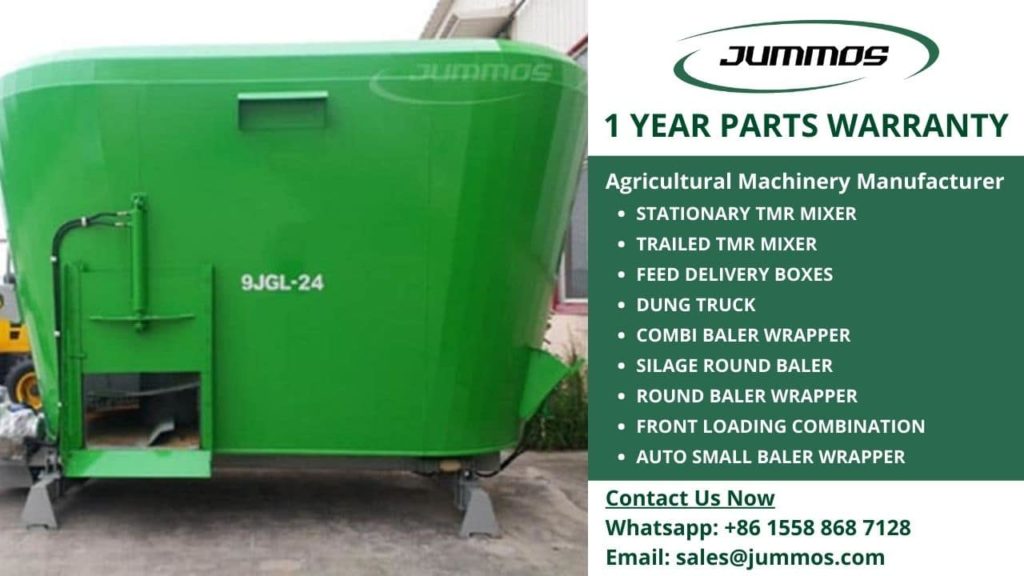
In a vertical mixer, a large auger turns on a vertical axis inside a tapered tub. The auger flighting carries material upward from the base, and as it reaches the top of the load it spills outward and cascades down the tub wall. Gravity returns it to the bottom, where the auger picks it up again. That loop is the whole mechanism, and the mixing happens in the cascade rather than in the auger itself, because that is the moment when particles that were travelling together get separated and redistributed.
Cutting is a second, separate function layered on top of the mixing. Knives bolted along the auger flighting shear long fibre as it passes, which is how a mixer turns a whole bale of hay into something a cow will eat as part of a blend. Most machines also carry restrictor plates or counter knives on the tub wall, and these are adjustable. Moving them inward slows the rotation of the load and forces more material across the knives, which processes long hay faster. Moving them outward lets the load turn freely, which mixes gently and preserves particle length. Many farms never touch these plates after delivery and lose a genuinely useful control as a result.
A horizontal mixer works on a different geometry. Two to four augers turn on horizontal axes, moving material front to back and side to side rather than up and over, and reel mixers use paddles instead of augers. Horizontal machines mix faster and treat particle length more gently, which is an advantage with an already chopped ration. Their weakness is processing long dry hay, which they do poorly unless specifically fitted for it. Neither layout is better in general, and the comparison is set out in our overview of feed mixer types.
| Vertical auger | Horizontal auger or reel | |
|---|---|---|
| Mixing motion | Lift, cascade down the wall, fold back in | Convey front to back and across |
| Processes long dry hay | Yes, this is its main strength | Poorly, unless fitted with knives for it |
| Effect on particle length | Reduces it, increasingly with time | Gentler, preserves length better |
| Typical mixing time | Longer, because cutting and mixing share the cycle | Shorter once material is already chopped |
| Sensitivity to fill level | High, needs a minimum depth to recirculate | Lower, but still needs augers covered |
| Handles whole bales | Commonly yes | Usually not without pre processing |
One Batch, From Loading to Discharge
Describing a single cycle makes the mechanism concrete, and it also shows where the decisions sit. The sequence below assumes a vertical mixer, which is the most common configuration on farms buying new today.
- Check the empty tub and zero the scale. Look for wire, bolts, stones and twine before anything goes in, because a mixer distributes contamination evenly through the entire batch. Confirm the weighing system reads zero so that every subsequent weight is real.
- Load long dry hay or whole bales first. They need the most processing time, so they go in while the tub is empty and the auger has room to work on them. Start the auger turning as you load rather than filling a static tub.
- Add the remaining forages. Silage and other wet forages follow, and they begin to coat the drier material, which is part of how the mix binds together.
- Add concentrates, minerals and additives. These are small in volume and expensive, so they go in once there is a mass of forage to carry them. Added to an empty tub they tend to settle into the base and stay there.
- Add liquids last. Molasses and water go in at the end, because liquid added early makes dry ingredients clump rather than disperse.
- Mix for the time your ration actually needs, then stop. This is the step most often got wrong, and the next section explains why.
- Discharge and watch the first and last of the load. Open the door and let the auger push material out. If the first metre of feed in the alley looks different from the last, the mix was not finished or the machine is overfilled.
Loading order follows from the mechanism rather than from tradition. The reason dry and long material goes first is that it needs the most auger passes, and the reason liquids go last is that they reduce the flowability the auger depends on. Change the order and the same machine with the same ingredients produces a worse ration.
Mixing Time Is Not a Texture Setting
There is a persistent idea that mixing longer simply makes the feed softer, and that the timer is a matter of preference. It is not. Mixing destroys particle length, and particle length in a dairy ration is a nutritional property with a job to do. Long fibre forms the rumen mat, stimulates chewing and saliva production, and buffers rumen pH. Mix past the point of uniformity and you are shortening the fibre that was supposed to perform that function, which raises the risk of rumen acidosis even though the ration on paper has not changed at all.
Under mixing and over mixing therefore fail in opposite directions. An under mixed load lets cows sort, selecting the grain and leaving the long forage, so the first cows at the barrier eat a richer ration than the last. An over mixed load cannot be sorted, which sounds ideal, but it no longer provides effective fibre. The target is the shortest mixing time that achieves uniformity, and that time is specific to your ingredients, your fill level and your knife condition rather than being a number you can copy from somebody else’s farm.
Mixing time is also the most useful diagnostic the machine gives you. Record how long a familiar ration takes to mix properly when the machine is new. When that time starts creeping upward, the knives have almost certainly gone round rather than the machine having developed a fault. Knives wear unevenly too, with the lower ones doing more cutting and dulling sooner, and the full picture is in our article on TMR mixer blades.
Farmers ask me what mixing time they should use and I cannot answer it from my desk, because the honest answer is the shortest time that gives you a uniform load. Mix a batch, check it, and write the number on the machine. That number belongs to your ration, and when it starts getting longer the machine is telling you the knives are finished. Sue Su, Marketing Director, Tsingtao Jummos Agricultural Technology Co., Ltd.
Why Fill Level Changes the Result
A vertical auger needs a certain depth of material around it to recirculate. Below roughly half of rated capacity, the load no longer folds over properly and instead rotates as a mass, which means it turns without actually mixing. Farms that buy a mixer sized for future herd expansion often discover this immediately, because their current batch size sits under the machine’s working minimum and no amount of extra mixing time fixes it.
Overfilling fails the same way for the opposite reason. The cascade needs free space above the load, so a tub filled to the rim has nowhere to fold material into and simply pushes it over the edge. This is also why stated capacity is a poor basis for comparing machines: a struck tub volume and a usable working volume can differ substantially, and only the second one matters. Ask any supplier for the maximum working batch in kilograms for a ration similar to yours, and our notes on feed mixer capacity and feed mixer specifications go through which figures predict real behaviour.
Checking Whether It Actually Mixed
The mechanism is invisible from outside, so the only way to know a mixer is working is to test the output rather than trust the timer. Two checks cover most of it, and both are farm level rather than laboratory work.
The first is a particle size check using a sieve separator, the common on farm tool being the Penn State Particle Separator, which is a stack of screens over a collecting pan. You shake a sample through it and weigh what sits on each layer. Commonly cited targets for a corn silage based lactating dairy ration look roughly like the table below, though they vary with ration type and your nutritionist’s own targets should take precedence over any published figure.
| Screen | Commonly cited target share | What it tells you |
|---|---|---|
| Top screen, longest particles | Roughly 2 to 8 percent | Too much invites sorting; too little suggests over mixing |
| Second screen | Roughly 30 to 50 percent | The effective fibre fraction that supports rumen function |
| Third screen | Roughly 30 to 40 percent | The bulk of the mixed ration |
| Bottom pan, fines | Usually under 20 percent | A high figure points to over processing |
The second check is a uniformity test along the discharge. Take samples from the start, middle and end of unloading, then compare them, either by eye for obvious differences or by having dry matter measured on each. A well mixed ration shows little variation between those points. If the last sample is visibly wetter or grainier than the first, the batch was either not mixed long enough or the machine was loaded beyond its working volume. Doing this once a season takes half an hour and catches problems that otherwise show up months later as inconsistent milk yield.
The Components That Do the Work
Understanding the mechanism makes the maintenance list obvious, because each part maps onto a function in the cycle. The auger lifts, so its flighting and its bearings matter. The knives cut, so their edges determine mixing time. The restrictor plates control processing intensity, so their adjustment is a setting rather than a fixture. The gearbox transmits the power, which makes it the most expensive component and the one most damaged by neglected oil. The load cells measure, which makes them the part that decides whether the ration is what the formulation says.
The tub liner is the component people forget. It wears from the inside as material tracks past the auger edge, and a thinning liner changes the clearance that the mixing action depends on. Run a hand down the inside of the tub quarterly and feel for thin spots and for the ridge that forms along the auger path. The detail on the lifting component itself is in our article on the feed mixer auger, and the structural thinking behind the whole machine is covered in feed mixer design.
Fasteners deserve a word because the original guidance on this point was vague. Knife bolts and auger flighting fasteners work in a vibrating, loaded environment, and they loosen. Check them on a schedule rather than when something sounds wrong, tighten to the torque the manual specifies rather than by feel, and check again after the machine’s first hours of work and after any knife change. A knife that comes loose inside a turning auger does expensive damage on its way out.
What the Machine Changes on the Farm
The nutritional case for a TMR is straightforward: the cow eats a consistent ration instead of selecting her own, which stabilises rumen function and makes intake predictable. Predictable intake is what allows a nutritionist to formulate meaningfully, because a ration only performs as designed if the animal actually consumes it as designed. On dairy units this usually shows up as steadier yield and fewer metabolic problems rather than a dramatic jump in production.
The labour case is real but often overstated in sales material. A mixer replaces the work of blending by hand or by loader bucket, and it lets one person feed a herd that previously needed several. It does not eliminate labour, since someone still loads, operates, discharges, cleans and maintains the machine. The honest framing is that it converts a large amount of unskilled repetitive work into a smaller amount of operator time, which is worth a great deal on farms struggling to recruit.
There is a third effect worth mentioning without overpromising it. Farms with spare mixer capacity sometimes sell mixed ration to neighbouring smallholders who cannot justify a machine of their own. That works where there are such neighbours within a sensible distance and where someone is willing to handle the commercial side, and it fails where either condition is missing. Treat it as a possible bonus rather than part of the purchase justification.
Jummos TMR Mixers
Tsingtao Jummos Agricultural Technology Co., Ltd. manufactures TMR mixers at No.173 Jufeng Road, Qingdao, China, in vertical and horizontal, single and multiple auger, stationary and trailed configurations, alongside balers, bale wrappers and manure handling equipment. Machines carry a twelve month warranty, and what matters more than the length is the mechanism behind it, so ask us who pays freight on a warranty part and how quickly it ships. We would rather answer that before the order than after.
Alongside mixers we build stationary TMR mixers, feed delivery boxes, the dung truck range, bale wrappers, combi baler wrappers and silage round balers. If you want the component brand list, the stated working batch capacity for a ration like yours, or the spare parts price list before committing, ask and we will send all three.
Frequently Asked Questions
What does TMR stand for?
Total Mixed Ration. It refers to a feeding method in which forage, grain, protein sources, minerals and additives are blended into one uniform feed, so the animal cannot select between components. It is sometimes written as total mix ratio, which is incorrect and causes confusion, since a ration is the daily feed allowance rather than a proportion.
How long should a TMR mixer run per batch?
There is no universal number, and copying one from another farm is a mistake. The target is the shortest time that produces a uniform load, which depends on your ingredients, your fill level and how sharp your knives are. Establish that time when the machine is new, write it down, and treat any increase as a sign the knives need inspecting rather than a reason to extend the timer.
Can you over mix a total mixed ration?
Yes, and it is a real problem rather than a theoretical one. Extended mixing shortens particle length, which reduces the effective fibre that forms the rumen mat and stimulates chewing, and that raises acidosis risk. The ration can look better and perform worse. Longer mixing is not a texture preference, it is a nutritional change.
Why does my mixer not mix well with a small load?
Because a vertical auger needs a minimum depth of material to recirculate. Below roughly half the rated capacity the load tends to rotate as a mass instead of folding over, so it turns without mixing, and extra time does not help. This is the main argument against buying a mixer much larger than your current batch size in anticipation of growth.
How do I know the ration actually mixed properly?
Test the output rather than trusting the timer. Take samples from the beginning, middle and end of the discharge and compare them, and run a particle size check with a sieve separator to confirm you still have enough long fibre. Doing both once a season takes about half an hour and catches problems long before they appear in yield figures.
Reviewed by Sue Su, Marketing Director at Tsingtao Jummos Agricultural Technology Co., Ltd., a manufacturer of TMR mixers, balers, bale wrappers and manure handling equipment based in Qingdao, China. Last reviewed 29 October 2026.