
Feed mixer capacity is quoted in cubic metres and livestock eat kilograms, and almost every sizing mistake lives in the gap between those two units. Before you compare models, you need one number: the volume of feed a single batch has to hold. That number comes from your animals’ intake and the bulk density of your ration, and once you have it the rest of the decision becomes straightforward. Work it out properly and you buy once. Guess at it and you either make four batches a day for the next decade or you own a machine your smallest feeding group cannot fill well enough to mix.
Why Feed Mixer Capacity Has to Be Measured, Not Estimated
Three things go wrong when capacity is chosen by feel rather than by calculation, and each of them costs money every day the machine is in use.
Shortfall and Surplus Both Cost You
A total mixed ration is a formulation, and producing it reliably means weighing each ingredient against your nutritionist’s recommendation. A mixer sized correctly supports that discipline because one batch matches one feeding for one group. Size it badly and the discipline erodes: too small and you are splitting groups across batches and losing track of what went where, too large and you are mixing more than the group eats and carrying leftovers that lose quality once exposed to air. Surplus mixed ration is not a resource unless you have a buyer for it the same day.
Fill Level Decides Whether It Mixes at All
The relationship between load size and mixing quality is not gradual at the extremes. Overfill and the auger has no free space above the load to lift material over and fold it back in, so feed spills over the rim and the mix never completes. Underfill and the load rotates as a mass instead of recirculating, which means the machine turns without mixing and extra time does not help. Extension guidance commonly puts a mixer’s usable mixing capacity at around 60 to 70 percent of its struck tub volume, which is the single most useful conversion in this whole subject and the one brochures rarely state.
Feeding Time Stops Expanding
Correct capacity means one load, one group, one trip. You are not going back to mix again because some animals missed out, and you are not holding leftovers. When you add stock, the calculation tells you immediately whether the existing machine still copes or whether you need an extra batch, rather than finding out at the barrier.
Step One: Intake
Dry matter intake is normally expressed as a share of body weight, and converting it into the as fed weight a mixer actually handles means dividing by the dry matter content of the ration. A typical mixed dairy ration sits near half dry matter, which roughly doubles the figure.
| Class of animal | Dry matter intake, share of body weight | Example | As fed, approximate |
|---|---|---|---|
| Lactating dairy cow | 3.5 to 4.0 percent | 650 kg cow, 23 to 26 kg DM | 48 to 55 kg per day |
| Dry dairy cow | roughly 1.8 to 2.0 percent | 650 kg cow, about 12 kg DM | around 26 kg per day |
| Growing or finishing beef | 2.2 to 2.5 percent | 450 kg steer, 10 to 11 kg DM | 21 to 24 kg per day |
| Replacement heifer | 2.2 to 2.6 percent | 350 kg heifer, 8 to 9 kg DM | 17 to 19 kg per day |
These are planning figures rather than prescriptions, and your nutritionist’s numbers should always take precedence, since intake moves with stage of lactation, ration quality, weather and water availability. They are close enough to size a machine, which is all they are needed for. Notice how far apart the classes sit: a lactating cow eats roughly twice the as fed weight of a dry cow, so your total depends on how the herd splits between groups rather than on headcount alone.
Step Two: Bulk Density
Somewhere in the calculation you need a density figure, and this is where most sizing errors originate. Mixed cattle ration commonly falls in the region of 300 to 450 kilograms per cubic metre once loose in the tub, with wetter and more finely chopped rations at the heavier end and dry straw based rations considerably lighter. A supplier quoting cubic metres and a farmer thinking in kilograms can both be right and still end up with the wrong machine, simply because neither stated the density they assumed.
Measure your own rather than borrowing a number. Weigh an empty container of known volume, fill it with your ration without pressing it down, weigh it again, and divide. Ten minutes of work gives you a figure specific to your feed that you will use in every capacity conversation from now on. The examples below use 400 kilograms per cubic metre, a reasonable middle figure for a silage based ration.
Step Three: The Calculation
Daily as fed weight, divided by batches per day, divided by density, gives you the volume of feed in one batch. Then divide by 0.65 to convert that into the struck tub capacity you need to buy, because the machine only mixes well in roughly the middle two thirds of its geometric volume.
| Operation | Daily as fed | Batches | Feed per batch | Struck capacity to buy |
|---|---|---|---|---|
| 30 lactating dairy cows | 1,500 kg | 1 | 1,500 kg, 3.8 m³ | roughly 5.5 to 6 m³ |
| 100 lactating dairy cows | 5,000 kg | 2 | 2,500 kg, 6.2 m³ | roughly 9 to 10 m³ |
| 100 lactating dairy cows | 5,000 kg | 1 | 5,000 kg, 12.5 m³ | roughly 18 to 21 m³ |
| 250 lactating dairy cows | 12,500 kg | 2 | 6,250 kg, 15.6 m³ | roughly 22 to 26 m³ |
| 200 finishing beef cattle | 4,800 kg | 1 | 4,800 kg, 12.0 m³ | roughly 17 to 20 m³ |
| 500 finishing beef cattle | 12,000 kg | 2 | 6,000 kg, 15.0 m³ | roughly 21 to 25 m³ |
Compare the two rows for 100 cows, because they contain the real decision. The same herd needs either a nine cubic metre machine run twice or a twenty cubic metre machine run once. The smaller one costs less, needs less tractor power and fits through more gateways. The larger one halves your loading and operating time every day of the year. Neither is correct in the abstract, and the answer depends on whether capital or labour is scarcer on your farm.
The Oversizing Trap
Buying extra capacity to cover future expansion sounds prudent, and on a farm with several feeding groups it frequently backfires. This is worth stating plainly because it reverses the advice you will often hear, including an earlier version of this page: bigger is not automatically safer.
The constraint is set by your smallest group, not your largest. Picture a dairy unit with 160 lactating cows, 25 dry cows and 30 heifers. The lactating group wants a big batch, but 25 dry cows at roughly 26 kilograms each is 650 kilograms, which is about 1.6 cubic metres. In a 24 cubic metre machine that batch occupies under seven percent of the tub. It will not mix, and no amount of extra time will make it mix, because the auger has nothing to recirculate against. The farm then hand mixes the small groups, feeds them something other than a proper ration, or admits it bought the wrong size.
Three ways out, all legitimate. Combine groups so each batch clears the working minimum, which is a nutritional decision for your adviser rather than an equipment one. Mix a larger batch and feed it over two days where the ration keeps. Or size for your smallest regular batch and accept more batches for the big group. Whichever route you take, ask the supplier directly for the minimum practical batch of the model you are considering, and treat an evasive answer as information. The mechanism behind all of it is explained in our article on how a TMR mixer works.
Why Stated Capacity Is Not Comparable Between Suppliers
Two machines can both honestly print twelve cubic metres and hold different amounts of usable feed. Some figures describe struck tub volume, the geometric capacity, and others describe rated mixing capacity, which manufacturers set anywhere from 60 to 90 percent of struck volume depending on the design. Unless you know which convention a figure follows, comparing two numbers tells you very little.
The question that cuts through it has nothing to do with cubic metres. Ask for the maximum working batch in kilograms for a ration like yours at a named dry matter percentage, and ask for the minimum practical batch alongside it. A supplier who can give both has tested the machine with feed in it. One who repeats the cubic metre figure has described the tub. The fuller list of which specification numbers are comparable is in our notes on feed mixer specifications.
Checking That Your Capacity Choice Actually Mixes
Capacity is a theory until you test the output. Two checks cover it, and both are farm level work rather than laboratory analysis.
The first is the tracer test, and the farm version of it is genuinely useful. Count a known number of marshmallows or similar visible items into the mixer with the final ingredients, then take samples from the start, middle and end of unloading, or along the length of the feed bunk after delivery, and count how many appear in each. Even distribution of the tracer indicates even distribution of your low inclusion ingredients, which is exactly what you cannot see by eye. This matters most for additives and minerals included at small rates, since those are the ones that quietly fail to reach every animal. The quantitative version of the same test uses salt content measured in a laboratory rather than a countable object.
The second is a particle size check with a sieve separator, which tells you whether you still have enough long fibre after mixing. Take samples of one to two quarts without sifting them, and pull two from each location if you want more confidence. A perfect mix does not exist, so expect some variation and discuss what is significant with your nutritionist rather than chasing a number.
Mixing Time: Most Farms Run Far Too Long
This belongs in a capacity discussion because mixing time is what you trade when you choose a batch size. Manufacturers typically recommend three to six minutes once everything is loaded. A survey of 49 Wisconsin dairy herds found the average in practice was around sixteen minutes, with a range from two to sixty, so the gap between recommendation and habit is enormous.
Extra time past the recommendation does not generally improve the mix. What it does is reduce particle size, which strips out the physically effective fibre that forms the rumen mat and stimulates chewing, and in some cases it actively causes segregation rather than preventing it. So a longer timer is not insurance. Establish the shortest time that gives you a uniform load, write it on the machine, and treat any creep upward as a sign to inspect the knives. Knives wear unevenly, the lower ones dulling first, and the detail is in our article on TMR mixer blades.
Power Capacity and the Other Physical Limits
A correctly sized tub on a machine your tractor cannot turn, or that will not fit down your feed passage, is still the wrong machine. The original version of this page raised door spacing and traffic lane width, which is a genuinely important point and worth expanding into the full set of constraints.
- Power at full load. Ask for the continuous requirement rather than a peak figure, and ask what it is with long dry hay or straw in the load, which is the hardest material a mixer handles. A machine that turns easily on silage can stall on straw. Note that a trailed or stationary mixer has no engine and therefore no fuel consumption of its own: it draws from the tractor PTO or an electric motor, so the figure you want is power, and fuel use belongs to the tractor.
- Height at loading and discharge. Your loader has to clear the rim, and indoors the roof has to clear the machine. A taller tub holds more volume in the same footprint, which is an advantage until it is not.
- Width and turning circle. Measure the narrowest point of the feed passage and the tightest turn on the route, doorways and steps included. This is the constraint most often discovered too late.
- Loaded axle weight. A full 24 cubic metre mixer is a heavy vehicle, and the yard surface, passage floor and any culvert or bridge on the route all have to take it.
Configuration interacts with capacity too. Horizontal machines mix faster and treat particle length more gently but handle long dry hay poorly, while vertical machines take whole bales and long fibre at the cost of longer cycles. Stationary units sidestep the transport constraints entirely but need a separate means of getting feed to the animals. The comparison is set out in feed mixer types.
Smaller Livestock, Different Problem
The same arithmetic works for sheep and goats, but the numbers land somewhere else and the minimum batch question becomes the dominant constraint rather than a footnote. A flock of 300 ewes eats a fraction of what 300 cattle eat, so the volume needed is small enough that many farms fall below the working minimum of the machines marketed to them. Chop length requirements differ as well, since smaller ruminants need a shorter presentation. We treat that case separately in the piece on the TMR mixer for sheep.
Getting a Straight Answer From a Supplier
Send your group sizes and your as fed intake figures, and ask for three numbers in writing: the maximum working batch in kilograms at a stated dry matter, the minimum practical batch for the same model, and the continuous power requirement with a straw based load. Those three tell you more than any brochure, and a supplier who cannot produce them has not tested the machine the way you are about to use it. The wider framework for checking out a supplier before paying anything is in our article on TMR mixer companies.
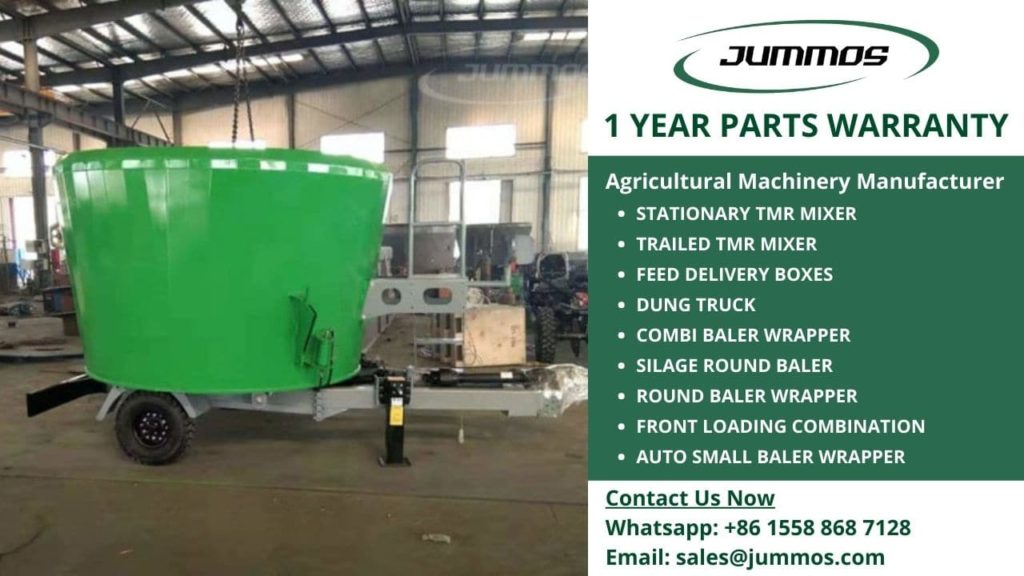
Jummos manufactures TMR mixers at No.173 Jufeng Road, Qingdao, China, in vertical and horizontal, single and multiple auger, stationary and trailed configurations, alongside balers, bale wrappers and manure handling equipment. Machines carry a twelve month warranty. Send us your group sizes and we will run the calculation above with you and give you the minimum practical batch for each model, including the cases where the honest recommendation is a smaller machine than you came looking for.
Frequently Asked Questions
What size feed mixer do I need for 100 cattle?
It depends what the cattle are and how many batches a day you will run. A hundred lactating dairy cows eating roughly 50 kg as fed need about 5,000 kg a day, which is around 12.5 cubic metres of feed at a typical density, so roughly a 20 cubic metre struck capacity for one batch or around 9 to 10 for two. A hundred finishing beef cattle eat less than half as much per head, so the same headcount needs a much smaller machine. Work from intake, never from headcount.
How full should a feed mixer be?
Usable mixing capacity is commonly put at around 60 to 70 percent of struck tub volume, though manufacturers rate their own machines anywhere between 60 and 90 percent. Above the rated figure you lose feed over the rim and the mix takes longer; well below roughly half, the load rotates instead of recirculating and will not mix at all. Ask your supplier for the rated mixing capacity rather than inferring it.
Is a bigger mixer always the safer purchase?
No, and this is the most common sizing error on farms with several feeding groups. A vertical mixer needs a minimum depth of material to mix, so a small dry cow or heifer batch in an oversized tub turns without mixing however long you run it. Size so your smallest regular batch clears the working minimum, and get that minimum figure in writing before you order.
How do I work out my ration’s bulk density?
Weigh an empty container of known volume, fill it with mixed ration without pressing it down, weigh it again, and divide the feed weight by the volume. Mixed cattle rations commonly fall between 300 and 450 kilograms per cubic metre, with wet finely chopped rations heavier and straw based rations lighter. It takes ten minutes and makes every later capacity discussion meaningful.
How long should I mix for?
Manufacturers generally recommend three to six minutes after loading, yet surveyed farms average far longer, around sixteen minutes in one Wisconsin study. Mixing past the recommendation mostly reduces particle size rather than improving uniformity, and can even cause segregation. Find the shortest time that produces a uniform load, record it, and treat an increase as a prompt to check the knives.
Reviewed by Sue Su, Marketing Director at Tsingtao Jummos Agricultural Technology Co., Ltd., a manufacturer of TMR mixers, balers, bale wrappers and manure handling equipment based in Qingdao, China. Last reviewed 29 October 2026.