
There are three main types of feed mixer: vertical auger mixers, horizontal auger mixers and reel mixers. They differ in how they move feed, which in turn decides what they can process, how much power they need and how gently they treat the ration. A vertical mixer can break down whole bales of hay but needs the most power. A horizontal auger mixer blends sticky silage and grain rations quickly on less power but cannot take whole bales. A reel mixer is the gentlest and most economical to run but needs every ingredient processed before it goes in. On top of those three, every mixer is also defined by how many augers it carries and whether it is stationary, towed by a tractor or self propelled. Choosing well means working through all three of those decisions in order, and this guide sets out how.
Three Ways to Classify a Feed Mixer
Most confusion about mixer types comes from mixing up three separate questions. The earlier version of this page said there are only two types, horizontal and vertical, which describes one of those questions but leaves out the others that matter just as much when you buy.
- Mixing action. Vertical auger, horizontal auger, or reel. This is the decision that determines what rations the machine can handle.
- Number of augers. Vertical mixers come with one, two or three augers. Horizontal auger mixers usually have three or four. Auger count largely sets capacity and, on vertical machines, mixing speed.
- Mobility and power. Stationary mixers sit in one place, usually driven by an electric motor. Trailed mixers are pulled and powered by a tractor through its PTO. Self propelled mixers have their own engine, and often their own loading system, in a single machine.
Settle the mixing action first, because it follows directly from your ration. Auger count follows from how much you need to mix per batch. Mobility follows from your farm layout and labour. Taken in that order, the decision is far simpler than a dealer’s catalogue makes it look.
Vertical Feed Mixers
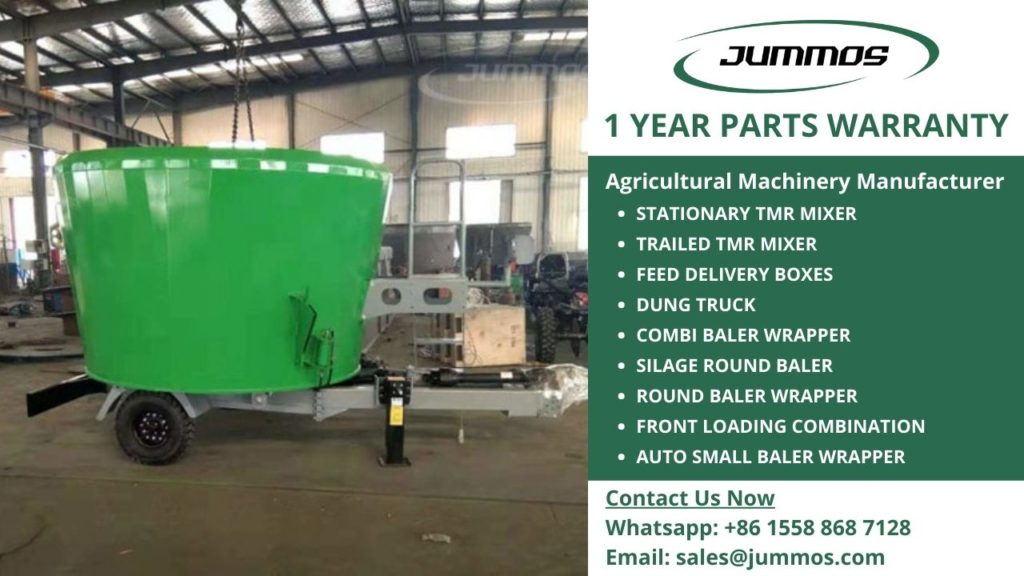
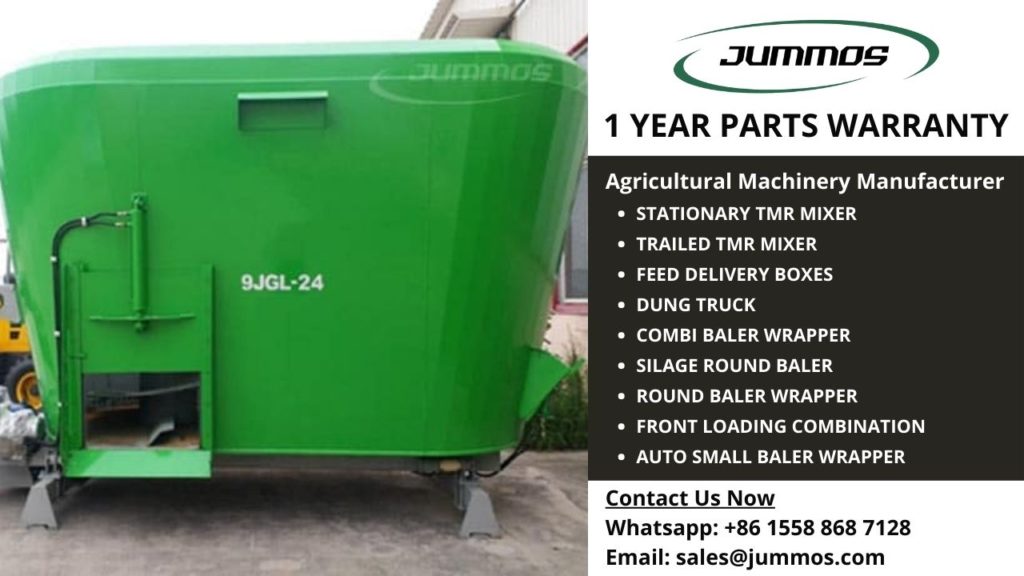
A vertical mixer has one or more large augers standing upright in a tapered tub, driven from below through a planetary gearbox. The auger flighting lifts feed up from the floor of the tub, the feed spills outward at the top and cascades down the tub wall, and the auger collects it again at the bottom. That loop repeats until the ration is uniform. Knives fitted along the auger flighting cut long material as it passes, which is why vertical mixers are the type to choose when the ration contains long hay or whole bales.
Bale processing is the vertical mixer’s defining strength. It can take an entire round or square bale and reduce it to a usable particle length inside the tub, so a farm needs no separate bale processor or tub grinder. Vertical mixers are also the easiest design to scale, by adding augers and enlarging the tub, so they offer the largest capacities on the market. The open top tub has no pinch points between moving parts, which simplifies loading with a front loader or telehandler.
The earlier version of this page described vertical mixers as less efficient than horizontal ones and mainly a favourite of small and medium farms. The first half needs qualifying and the second half is not accurate. Vertical mixers do generally need more power than horizontal or reel mixers for the same volume, and they can over process a ration if left mixing too long. But their scalability means twin and triple auger vertical mixers are standard on large dairy operations, not just small farms. They also have a fill level constraint worth knowing: they perform best close to full, because a small batch in a large tub turns as a mass instead of folding over. The mechanism behind that, and why mixing time matters so much, is explained in our article on how a TMR mixer works.
Auger count on a vertical mixer is mainly about capacity and speed. A single auger machine suits smaller batches and is the simplest and cheapest to maintain. Twin and triple auger machines handle larger batches and mix them faster, at the cost of more power and more wear parts. The trade offs are set out in our guides to the single auger TMR mixer and the multiple auger TMR mixer.
Horizontal Auger Mixers
A horizontal auger mixer lays its augers lengthways along a trough shaped body, usually three or four of them, with four the most common arrangement. Typically the lower augers carry feed forward while the upper augers carry it back, and the material is compressed and turned over where the flows meet. That compression is what makes horizontal mixers good at blending sticky, dense or hard to move ingredients quickly, such as wet silage, molasses and by products, and it lets them do so on less power than a vertical mixer of similar volume.
The limitation is long fibre. Horizontal auger mixers cannot process whole bales, and their tolerance for long stem forage is limited. One major manufacturer’s guidance puts the limit at around 25 percent long stem forage in the ration, or about 40 percent if that forage has been processed beforehand. Some horizontal machines carry knives on their augers to cut long material, which extends what they can handle, but a farm feeding a large share of long hay is usually better served by a vertical mixer. That answers the common search about the purpose of a horizontal mixer: it is built for fast, efficient blending of silage and concentrate based rations rather than for breaking down hay.
Horizontal machines also tend to be lower and longer than vertical ones of similar capacity, which can help under low roof lines and with low loading heights. More detail on configurations, including four auger designs, is in our article on the horizontal TMR mixer.
Reel Mixers
A reel mixer is a horizontal machine with a different mixing element: a large rotating reel, a cage of bars or paddles running the length of the body, working alongside two augers. The reel lifts and tumbles the feed while the lower auger moves it towards the discharge door and the upper auger levels the load. The tumbling action is the gentlest of the three mixer types, which means reel mixers preserve particle length better than any other design. They also have the lowest power requirement, blend partial loads quickly and empty out very cleanly, which matters when you change rations between groups.
The price of that gentleness is that a reel mixer does no processing. The clearance between the reel and the tub wall is tight, so ingredients need to be chopped or processed before loading, and whole bales cannot go in at all. Reel mixers are also sensitive to overfilling. They are a natural fit for operations feeding pre processed, consistent rations in volume, which is why they are widely used in commercial feedlots, and they are the type behind the search term horizontal reel mixers.
Buyers often ask which mixer type is best, and the honest answer is that the ration decides it. If you feed long hay or whole bales, you need the processing ability of a vertical mixer. If everything you feed is already chopped, you are paying for power and wear you will never use. Start with what goes into the tub, and the type follows. Sue Su, Marketing Director, Tsingtao Jummos Agricultural Technology Co., Ltd.
Vertical vs Horizontal vs Reel: Side by Side
The table below brings the three types together. It is a general guide, and individual machines vary, especially horizontal mixers fitted with processing knives.
| Vertical auger | Horizontal auger | Reel | |
|---|---|---|---|
| Whole bales and long hay | Yes, its main strength | No whole bales; limited long stem forage | No; ingredients must be pre processed |
| Power requirement | Highest for a given volume | Lower | Lowest |
| Effect on particle length | Reduces it; can over process if mixed too long | Moderate | Gentlest; best preservation |
| Sticky, dense ingredients | Good | Very good, through compression | Good |
| Capacity range | Widest; easiest to scale with more augers | Medium to large | Medium to large |
| Fill level sensitivity | Performs best near full | Moderate | Sensitive to overfilling |
| Typical use | Dairy and beef rations with hay or bales, any herd size | Silage and grain rations, lower power budgets | Pre processed rations in volume, commercial feedlots |
Read across the first row and the decision often makes itself. If your ration includes a significant amount of long hay or whole bales and you do not have separate processing equipment, the choice is a vertical mixer. If it does not, compare horizontal and reel designs on power, particle length and the way you load and unload.
Stationary, Trailed and Self Propelled Mixers
Any of the three mixing types can come in different mobility configurations, and this choice is about farm layout and labour rather than ration.
| Configuration | Power source | Fits best when |
|---|---|---|
| Stationary | Usually an electric motor | A central feed centre, with mixed ration moved by conveyor, feed cart or wagon; low running cost and quiet operation |
| Trailed | Tractor PTO | Mixing and delivery in one machine using a tractor the farm already owns; the most common choice on mixed farms |
| Self propelled | Own engine, often with an integrated loading cutter | Large operations where speed and labour saving justify the highest purchase price |
Stationary electric mixers are worth a closer look than they often get. They run on cheaper energy than diesel, work well in a covered feed centre, and suit farms where distances to the feed alley are short or where feed is delivered by other means. Trailed mixers combine mixing and delivery but tie up a tractor every feeding. Our guides to the stationary TMR mixer, the trailed TMR mixer and the electric TMR mixer cover each in detail.
How to Choose the Right Type
The earlier version of this page noted that farmers used to choose mixers by habit and by how close the nearest dealer was, with spare parts availability as the deciding factor. That last point remains sound advice. The rest of the decision is better made in a fixed order.
- Start with the ration. List what goes into the mixer, and note how much is long hay, straw or whole bales. This decides between vertical and horizontal or reel.
- Work out batch size. Calculate daily as fed weight per group and batches per day, then convert to volume. That sets capacity and, on vertical mixers, the number of augers. Our guide to feed mixer capacity walks through the arithmetic, including why buying too big is a real risk.
- Check your power. For a trailed mixer, confirm your tractor’s continuous PTO power with the hardest ration you feed. For a stationary mixer, confirm the electrical supply.
- Measure your layout. Height for loading, width and turning circle in the feed passage, door openings and floor loading.
- Compare the specifications that last. Steel thickness in the wet zone, gearbox and bearing brands, knife material and replaceability, and the weighing system. Our article on feed mixer specifications explains which numbers are comparable between suppliers.
- Check the supplier. Spare parts availability, warranty terms and after sales support decide the machine’s working life. Our guide to TMR mixer companies covers how to verify a supplier before you pay.
A mixer is a long term investment rather than a quick return, and it pays back through more consistent rations, less feed waste and steadier animal performance over years. Working with a nutritionist on the ration, and running the machine at the right fill level and mixing time, matters as much as the type you buy. The knives in particular deserve attention, since worn knives slow mixing on every type; see our guide to TMR mixer blades.
How the Types Developed
Horizontal mixers came first, developed for feedlots where forage was chopped or processed before mixing with concentrate. Knives were later added to horizontal augers so that some longer material could be handled without separate processing. Vertical mixers spread more widely as round bale feeding grew, because their ability to break down a whole bale in the tub removed the need for a separate processor. Reel mixers developed alongside as the specialist option for gentle, high volume mixing of pre processed rations.
The earlier version of this page gave specific dates for several of these steps, including the claim that reel mixers were introduced in 2013. We have not been able to verify those dates, and reel mixers were in commercial use well before then, so we have removed them rather than repeat figures we cannot stand behind.
Jummos Feed Mixers
Tsingtao Jummos Agricultural Technology Co., Ltd. manufactures TMR feed mixers at No.173 Jufeng Road, Qingdao, China, in vertical and horizontal configurations, with single and multiple augers, in stationary and trailed versions, alongside balers, bale wrappers and manure handling equipment. Tell us what goes into your ration, how many animals you feed in how many groups, and what power and layout you have, and we will recommend the type and size that fits, including when a smaller or simpler machine is the better answer. Machines carry a twelve month warranty, and we will send the component list and spare parts price list before you order.
Frequently Asked Questions
What are the main types of feed mixer?
Vertical auger mixers, horizontal auger mixers and reel mixers. Vertical mixers process whole bales and long hay but need the most power. Horizontal auger mixers blend silage and grain rations quickly on less power but cannot take whole bales. Reel mixers are the gentlest and lowest powered but need pre processed ingredients. Each can be stationary, trailed or self propelled.
What is the difference between a vertical and a horizontal feed mixer?
A vertical mixer lifts feed with upright augers and lets it cascade down the tub wall, cutting long material with knives on the auger, so it can process whole bales. A horizontal mixer moves feed lengthways with three or four augers and compresses it where the flows meet, which blends sticky ingredients fast on less power but cannot handle whole bales. Choose vertical if your ration includes much long hay; otherwise compare horizontal and reel.
What is a horizontal mixer used for?
Fast, efficient blending of silage, grain, by products and liquid ingredients, particularly in rations that contain little long stem forage. Horizontal auger mixers use less power than vertical mixers of similar volume and handle dense, sticky ingredients well. They are common in feedlots and on farms where forage is chopped before mixing.
Which feed mixer type is best for a small farm?
It depends on the ration more than the farm size. A small farm feeding long hay or whole bales usually needs a single auger vertical mixer, sized so its smallest regular batch still fills the tub enough to mix. A small farm feeding chopped silage and concentrate may do better with a compact horizontal or a stationary electric mixer, which use less power.
Reviewed by Sue Su, Marketing Director at Tsingtao Jummos Agricultural Technology Co., Ltd., a manufacturer of TMR mixers, balers, bale wrappers and manure handling equipment based in Qingdao, China. Last reviewed 11 November 2026.