
Erratic weather and unpredictable price increases both put pressure on a livestock feeding programme. The good news is that there are sound ways to bring feed costs down without compromising nutrition, safety, or efficiency. Before getting to them, it helps to review what animal feed actually is and how it is classified.
What Is Animal Feed?
Animal feed is any organic or inorganic material consumed by livestock, whether ruminants, non-ruminants, or poultry. The purpose of feeding is to meet all of an animal’s basic requirements, covering maintenance, growth, reproduction, production, lactation, and general health.
Why Feed Matters So Much Commercially
Feed is the largest single cost in livestock production, commonly accounting for around 70 percent of total production cost. That alone makes it the first place to look when margins tighten.
Beyond cost, animals need balanced nutrition just as people do, and their requirements vary with species, age, growth phase, body condition, reproductive state, body weight, and environment. Good feed meets those requirements. Poor feed invites disease and disrupts production, which ends up costing the farmer considerably more than was saved.
Types of Animal Feed
Feed is often discussed in terms of its physical form, such as pellets, crumble, or mash. More usefully, it divides into two categories based on nutrient density.
| Forage (Roughage) | Concentrate | |
|---|---|---|
| Crude fibre | High, generally above 18 percent | Low, generally below 18 percent |
| Typical sources | Grass, leaves, hay, silage, crop residues | Cereal grains, bran, oilseed meals, milling by-products |
| Role in the ration | Bulk and fibre that keeps the rumen functioning | Concentrated energy and protein |
The distinction is worth getting right, because concentrate is defined by what it is not: it is feed that is low in crude fibre and easily digested, which is precisely the opposite of forage. Concentrates are built from grains and processing by-products rather than from forage itself.
Ways to Cut Feed Cost Without Cutting Nutrition
Reducing the ration is the obvious move and also the worst one, since underfeeding costs production and condition. The better approach is to lower the cost of the feed while keeping its nutritional value intact.
Make Silage
Silage is one of the most effective ways to lower feed cost, because it lets you preserve forage when it is abundant and cheap, then feed it when it is scarce and expensive. It also puts crop residues such as straw to use rather than leaving them as waste.
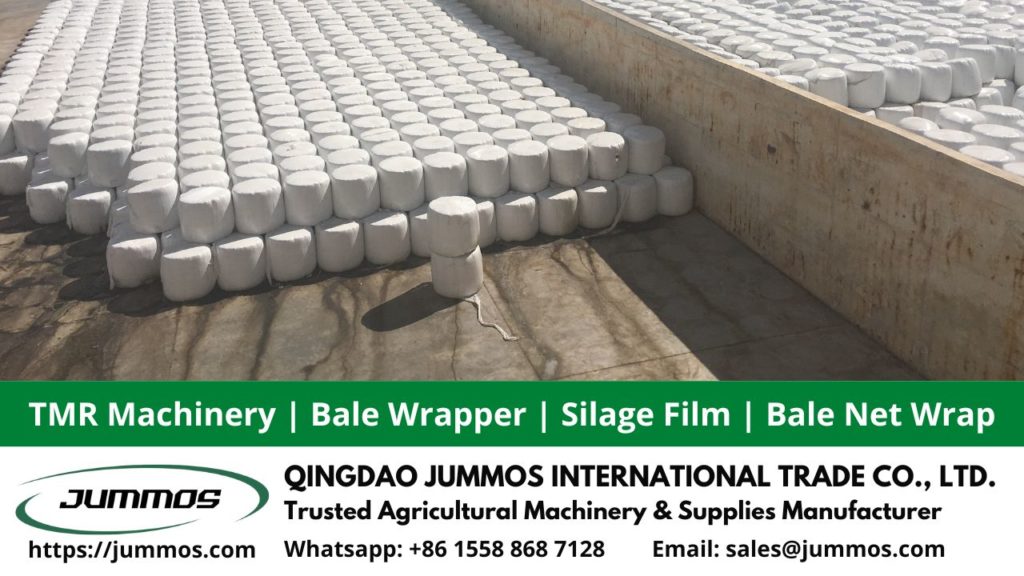
Silage is made by preserving forage at a moisture content of roughly 60 to 70 percent in an airtight environment, where fermentation stabilises over about three weeks. That airtight environment can be a bunker, a silo, a bag, or a wrapped bale.
Compared with hay, which preserves forage by drying, silage offers several advantages.
- It is far less vulnerable to rain damage at harvest, since the crop does not need days of dry weather to cure.
- Fewer leaves are shattered and lost during handling, and the leaf is where much of the nutrition sits.
- Carotene is better retained than in sun-dried hay.
- It is generally more digestible than hay cut at the same maturity.
Good silage is readily eaten by livestock. It has a pleasantly sour aroma, is not rancid, does not clump, is neither mouldy nor slimy, and typically shows a yellowish-green colour.
One important note on species. Silage suits cattle and sheep well, and dairy cattle in particular rely on it heavily, with maize silage forming the backbone of many dairy rations. Horses are the exception that needs real caution. As hindgut fermenters, horses are the most susceptible of common livestock to mould, and they are also vulnerable to botulism from poorly fermented baleage. If you keep horses, seek specific advice before feeding them any ensiled forage.
Use a Proper Silo or Wrap
Besides errors in the making, silage most often fails because the storage leaks. Air entering the silo or the bale is what allows spoilage organisms to take hold, so the quality of the sealing material matters enormously.
Silos can be horizontal or vertical, and on larger farms they are usually permanent structures. A good silo may be a metal cylinder or a concrete bunker or pit, and there are also quality options built from resin, film, drums, or plastic. Whatever the form, the principle is the same: the store must be airtight so that an oxygen-free, acidic environment develops and fermentation completes properly. Our guide to agricultural silage film covers the sealing side for baled silage.
Make the Most of Grazed Grass
Grazed grass remains the cheapest feed available, and elephant grass in particular performs well in tropical conditions. A few practices help you get more from it.
- Build your forage supply early, while conditions are still favourable, rather than waiting until the lean season arrives.
- Preserve the surplus promptly as silage in a pit or as wrapped bales.
- Test your soil so that fertiliser can be matched to what the ground actually needs rather than applied by habit.
- Apply lime only where soil testing shows it is required, and avoid liming fields shortly before a silage cut, since it can interfere with fermentation.
- Plan for continuity, keeping enough reserve to cover more than a single feeding period.
Group Animals by Requirement
Feeding every animal the same ration wastes money on some and shortchanges others. Separate productive from unproductive stock, and separate pregnant animals by stage, distinguishing mid-pregnancy, late pregnancy, and lactating animals. Requirements differ substantially between those groups, and matching feed to group is one of the cheapest efficiency gains available. Our article on the total mixed ration covers how grouping works in practice.
Consider Alternative Feeds, Carefully
Several alternative feedstuffs can reduce cost, including crop processing residues, surplus vegetables and fruit, and agricultural by-products. Processing techniques such as Urea Molasses Block supplementation, hay making, and ammoniated or fermented straw treatment can also stretch a feed budget considerably.
There is an important limit here, and it deserves emphasis because cheap feed advice often skips it. Do not feed mouldy or rotted material. Some moulds produce mycotoxins, and these cannot be identified by eye, so visual inspection is not a reliable safety check. Animals consuming contaminated feed can suffer liver and kidney damage, neurological disorders, and estrogenic effects, along with reduced intake, poor fertility, and in some cases mycotic abortion. Ruminants tolerate mycotoxins somewhat better than other species because rumen microbes break some of them down, but young calves and high-producing animals remain at real risk. Spoiled feed also carries a human health risk, since inhaling the spores can cause respiratory illness.
If you are unsure about a batch, mould and mycotoxin testing is available and inexpensive relative to losing animals or a season’s production. As a rule, avoid questionable feed entirely for young, pregnant, or lactating stock.
Feeding food waste also carries regulatory restrictions in many countries because of disease transmission risk, so check the rules that apply where you farm before going down that route.
Counting the Real Cost
Before committing to any cheaper feed, price the whole picture rather than the ingredient alone. That means the feed cost, transport, handling, the actual nutritional value delivered, and how the material will be stored and handled to limit spoilage. A feed that is cheap at the gate but loses a third of its value in storage is not cheap.
This is where equipment earns its place in a cost calculation. Preserving forage properly and mixing it consistently protects the value of what you have already bought. Jummos manufactures baler wrappers for sealing forage and TMR mixers for feeding it as a balanced ration. Tell us your herd and your forage situation and we will help you work out what makes sense.
Frequently Asked Questions
What is the cheapest feed for livestock?
Grazed grass is generally the cheapest feed available, which is why building your grazing and forage supply is the first place to look. The next cheapest option is usually silage made from your own surplus forage and crop residues, since it converts material that is abundant in the growing season into feed available during the lean months. Bought-in concentrate is almost always the most expensive component, so reducing dependence on it is where the savings come from.
Is it safe to feed spoiled or mouldy feed to save money?
No. Some moulds produce mycotoxins, and they cannot be identified visually, so you cannot judge safety by appearance. Contaminated feed can cause liver and kidney damage, neurological problems, reduced fertility, and mycotic abortion, and the spores also present a respiratory risk to the people handling it. Ruminants tolerate some mycotoxins better than other species, but young calves, pregnant animals, and high-producing stock remain vulnerable. Testing is available and costs far less than the losses it prevents.
Can all livestock eat silage?
Cattle and sheep handle silage well, and dairy cattle in particular depend on it, with maize silage central to many dairy rations. Horses need genuine caution, since as hindgut fermenters they are the most mould-susceptible of common livestock and are also vulnerable to botulism from poorly fermented baleage. If you keep horses, take specific advice before feeding ensiled forage.
What is the difference between forage and concentrate?
The distinction is nutrient density and fibre content. Forage is high in crude fibre, generally above 18 percent, and provides the bulk and physical fibre that a ruminant needs for proper rumen function. Concentrate is low in crude fibre, generally below 18 percent, and delivers concentrated energy or protein. Concentrates come from cereal grains, bran, oilseed meals, and milling by-products rather than from forage, and the two categories work together rather than substituting for one another.
Reviewed by Sue Su, Marketing Director of Jummos, on September 28, 2026. Feed safety and classification guidance was checked against current extension and veterinary references to keep the information accurate and safe for farmers.