
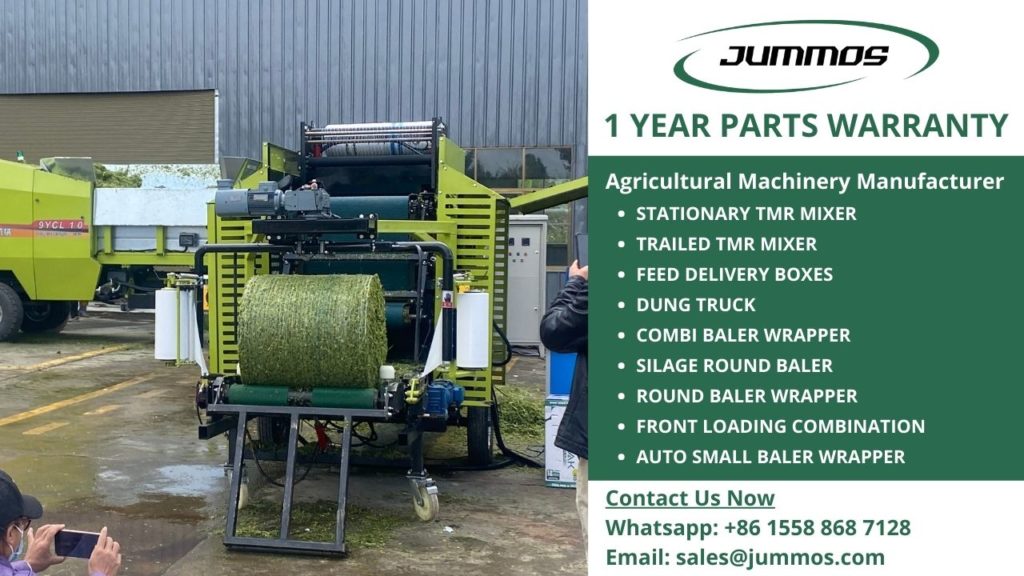
A silage baler machine supports one of the most important parts of any livestock operation. Animals depend entirely on their feed, and how that feed is chosen and managed is often what separates a farm that works from one that struggles.
This guide covers what the machine does, the correct order of the silage process, and what to look for when choosing one. The sequence matters more than people expect, so that is where we will start.
The Correct Order of the Silage Process
This trips up a surprising number of people, and getting it wrong costs an entire crop. Fermentation is not something you do before baling. It is something that happens inside the sealed bale afterwards.
| Step | What Happens |
|---|---|
| 1. Cut | Forage is harvested at peak growth, while nutritional value is highest |
| 2. Bale | The silage baler machine compresses the forage into a dense, uniform bale |
| 3. Wrap | Film is applied in layers to seal the bale and exclude oxygen |
| 4. Ferment | Lactic acid bacteria work inside the sealed bale, dropping the pH and preserving the forage |
| 5. Store | Bales are kept sealed and undamaged until they are needed |
Two details within that sequence are worth emphasising.
The first is timing between steps two and three. Forage quality starts degrading as soon as the crop is cut, and the decline accelerates once a bale is formed. Research on wrapping delays puts the threshold for quality reduction at around four hours after baling, and extension guidance commonly recommends wrapping within four hours, treating 24 hours as an outer limit. Bales wrapped immediately generally stay below 100 degrees Fahrenheit internally, while bales left for a day have already heated to around 130 degrees by the time they are sealed. That heat is protein and energy leaving the bale.
The second is when you harvest. Forage is cut during the growing season, when rain has brought the crop to its peak. It is fed during the lean season, when the field has nothing to offer. Cutting during a drought to make silage defeats the entire purpose, because you would be preserving material that has already lost its value.
Feed Quality Determines the Product
Cattle are among the most common farm animals, and they produce a range of outputs, with beef and milk the most commercially significant. Feed quality determines both the quality and the quantity of what you get.
Some people believe the success of a cattle operation rests on genetics. Genetics matters, but it is not the whole story. Superior breeding that is not supported by the right nutrition delivers very little. A well-bred animal that is underfed will still become sick, because intake and output are directly linked. Once you decide to raise animals commercially, you need a target, and reaching it takes careful calculation rather than good stock alone.
Why Consistency Is So Hard to Maintain
A good feeding system counts for nothing if it only runs occasionally. Nutrition has to be delivered consistently, because growth is disrupted whenever the system falters.
Maintaining that consistency is hardest in tropical regions, and the reason is seasonal. Dry season temperatures run higher, and the plants growing in that heat are a different feed from the same plants in the wet season. Nutritional value drops away and what is left behind is closer to residue than to quality forage.
Water is the underlying cause, and although it is only one component, it is the one that carries everything else. When plants dry out badly, or die outright, the feed supply falls short of what the herd needs. Animals become more vulnerable to disease, condition declines, and fertility suffers, which disrupts the reproduction cycle and carries the problem into the following season.
Solving the Feed Problem
Feed shortages are not a new problem, and the answer farmers and nutritionists settled on is to preserve forage rather than chase it.
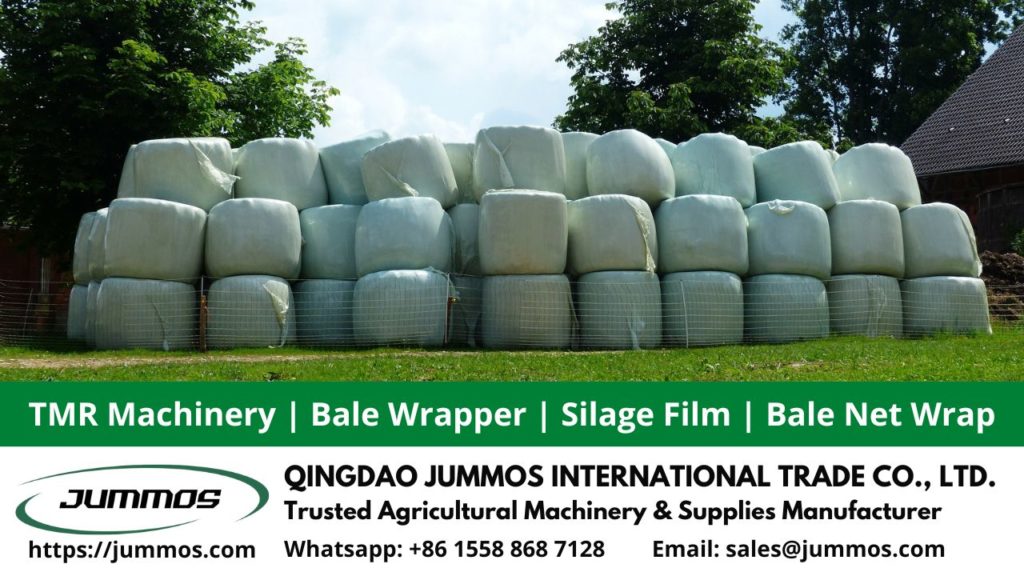
Start by harvesting at the right moment, which means during the growing season while the crop is at its best. Bale it promptly, wrap it quickly, and let fermentation do its work inside the sealed bale. Then store it properly, because storage is where preventable losses happen. Bales need to be kept where the film will not be punctured, on clean ground, away from damage by machinery, animals, or birds. A torn wrap admits oxygen, and the resulting spoilage usually goes unnoticed until the bale is opened.
Getting the storage right is what guarantees the feed will actually be there when the dry season arrives.
Why Use a Machine at All
Some farmers remain sceptical of mechanised equipment and prefer manual methods. That view holds up on a small scale, but it breaks down quickly as the operation grows. When there are hundreds of animals to feed, machinery stops being a convenience.
The economics are straightforward. A machine reduces the labour bill, since a job that previously needed a team can be handled by a few people. It compresses the time the work takes, which matters enormously given the four-hour wrapping window. And it produces bales of consistent size, which makes storage planning and stacking far simpler than dealing with bales that vary from one to the next.
The machine still needs an operator, of course, though often little more than loading and controlling the cycle. What it removes is the physical labour and the delay, and the delay is the part that costs you feed quality.
Choosing a Manufacturer
You do not need deep technical expertise to judge a manufacturer, just a sense of what a credible one looks like.
Check that they have a real website and a verifiable physical location, so you know where to turn if something goes wrong with the machine. Confirm the warranty, where one year on parts is the normal standard. Look at whether they produce a genuine range rather than a single machine, since a manufacturer with options can recommend what fits your farm instead of steering you toward the only thing they make. And ask whether they also supply the consumables, because film and machine working as a matched pair avoids a common source of problems.
Jummos manufactures agricultural machinery from our factory in Qingdao, China, with a one-year parts guarantee and SGS audited supplier status. Our range includes combi baler wrappers that bale and seal in a single pass, compact machines for smaller farms, TMR mixers, and manure cleaning trucks. Our sister brand Silopak produces the silage film and net wrap that go with them.
Tell us your forage volume and how far your baling runs from your storage, and we will recommend a configuration that suits the way you actually work.
Frequently Asked Questions
Does fermentation happen before or after baling?
After, and this is a common misunderstanding worth correcting. The correct sequence is to cut the forage, bale it, wrap it in film to exclude oxygen, and then allow fermentation to take place inside the sealed bale. Lactic acid bacteria convert the plant sugars into lactic acid, which lowers the pH and preserves the forage. Nothing ferments before baling, and attempting to work in that order will simply spoil the crop.
When should forage be harvested for silage?
During the growing season, while the crop is at peak nutritional value. Silage exists to move that nutrition into the lean season, so the harvest happens when the field has the most to give and the feeding happens when it has the least. Cutting during a drought to make silage is self-defeating, because you would be preserving forage that has already lost much of its protein, mineral content, and energy.
How quickly should bales be wrapped after baling?
As soon as practically possible. Research puts the threshold for forage quality reduction at approximately four hours after baling, and extension guidance commonly recommends wrapping within that window, with 24 hours as an outer limit rather than a plan. Bales wrapped immediately generally stay below 100 degrees Fahrenheit internally, while those left 24 hours had already reached about 130 degrees by wrapping time, and that heating consumes digestible protein and energy.
Is a silage baler machine worth it for a small farm?
It depends on volume rather than on principle. For a handful of animals, manual methods can work. As herd numbers rise, the labour cost of manual baling becomes difficult to justify, and more importantly the time it takes makes the four-hour wrapping window hard to meet. Compact machines exist specifically for smaller operations, so the question is usually which size of machine rather than whether to have one at all.
Reviewed by Sue Su, Marketing Director of Jummos, on September 15, 2026. Process sequence and wrapping timing were checked against current forage extension research to keep the guidance accurate for farmers.