
Agricultural businesses are not only for local people in villages or rural areas, old people over the age of 60 who want to enjoy retirement, and people with low education now. People call it modern agricultural business since it has proven to have touched many circles, ranging from office employees, housewives, workers who decide to retire early, artists, celebrities, to company CEO’s who see opportunities for this lucrative business. The support of agricultural machinery has also made a wave of interest in the agricultural business even bigger.
What Is Agricultural Machinery?
It is called modern when something has machinery and technology touch inside. The agricultural machinery is all we need to succeed in agricultural business. The mechanism inside the agricultural machinery at least can cover some basic needs in agricultural land, such as cutting or pruning the creeping parts of plants, trimming plant pieces into bales (round or square shape), transporting feed and crops, transporting fertilizers, to chopping certain plant parts for purposes such as feeding livestock.
Many types of agricultural machinery can do all those basic needs. There are hand tools, electric power tools, tractors, to agricultural machinery that workers pull or operate. Modern agriculture needs agricultural machinery for the process of planting to harvesting. According to the Food and Agriculture Organization of the United Nations (FAO), agricultural mechanization plays a key role in improving farm productivity, reducing labor burden, and supporting food security across the globe. Machines were even created to distribute agricultural products to end customers.
Hay Wrapping Special Tractor
What does the tractor mean to you? One of these mini agricultural machinery is a mandatory item that agribusiness entrepreneurs need to be able to plow acres of rice fields. Then, what is a special hay wrapping tractor?
A round bale wrapper is one of the agricultural machinery which is designed to work alongside a tractor with additional functions built in. The hay that has been collected in the middle of the meadow will be shaped in a round shape and then wrapped in a high tensile rate and good sealing performance film. You can wrap 40 to 50 bales per hour. Even during the bale wrapping process, you will be amazed by the high degree of automation this machine provides. The wrapped hay bales will later become high-value storage for animal feed or handicraft business materials. You can remove bale wrappers when you want to use them. You can order this automatic round bale wrapper from us.
TMR Mixer You Can Count On
How much do you need a TMR mixer? If you are an agribusiness entrepreneur who also has animal husbandry, you need one of these agricultural machinery. Likewise, with those of you who are in the field of animal feed business.
So, what is a TMR mixer? For a brief explanation, TMR (Total Mixed Ration) is a complete feed or type of animal feed consisting of forage and concentrate in adequate proportions. If TMR is not mixed using a special machine, it will be very difficult for the livestock to chew the food. Farm animals such as cows often choose long chunks of food in search of finer particles.
The farms that don’t have a TMR mixer usually just mix all the concentrate and the forage. As a result, the TMR size obtained manually mixed by hands is coarse. The cow chooses long particles. If this habit continues every day, it will be bad for the cows. Cows can have metabolic disorders such as rumen acidosis. The TMR mixer helps breeders provide quality feed for their livestock. Understanding the right feed mixer specifications is also important to ensure you get the most out of this machine for your farm’s specific needs.
You can also open a new animal feed business by using one of these agricultural machinery. You can see the best selections of our TMR mixers and find the TMR mixer that best suits your needs.
Feed Or Fertilizer Spreader
One of the agricultural machinery in the form of two-wheeled, three-wheeled, or four-wheeled vehicles is a machine that transports fertilizer or animal feed. As someone who is in the agricultural business in this modern era, you need this feed or fertilizer spreader.
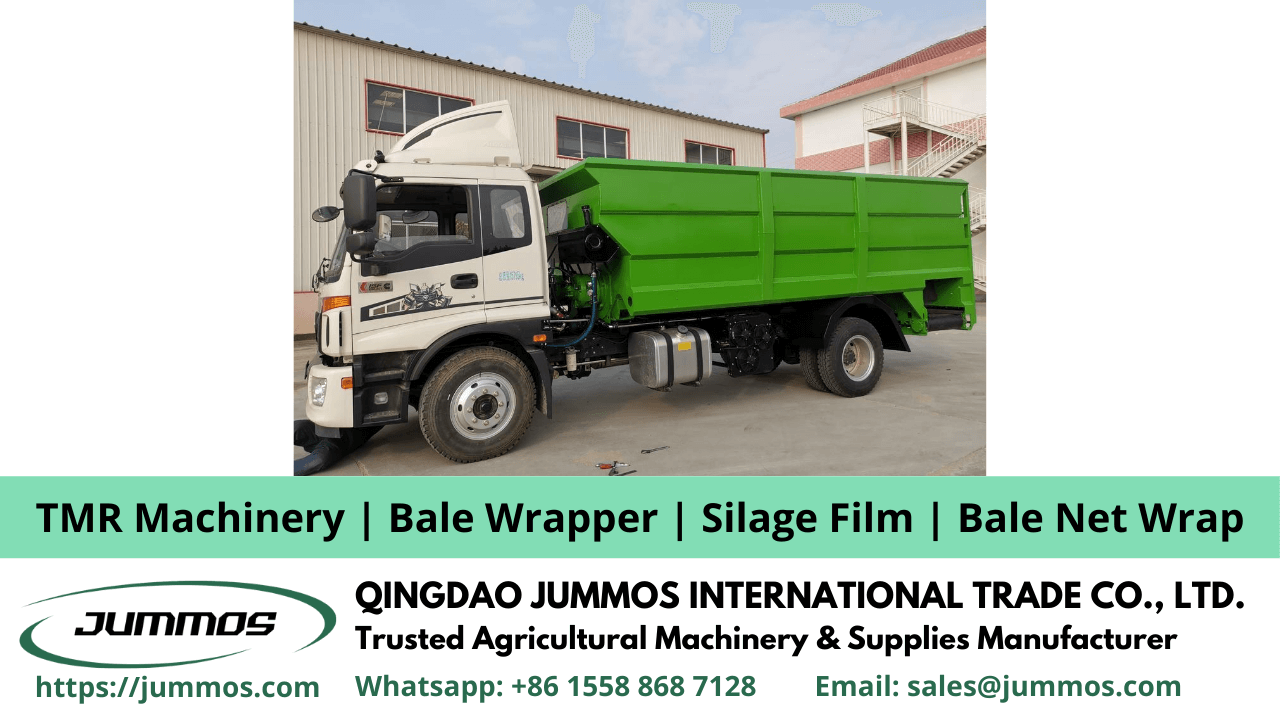
The shape is exactly like a truck or motor equipped with an auger drive in the form of a hydraulic motor, a conveyor belt for the spreading way, an oscillating tube, or a disc with a pallet. Sometimes the manufacturer of these agricultural machinery provides color customization services and spreader capacity according to customer demand.
Jummos Agriculture Supplies provides Feed Delivery Boxes which makes it easier for you to transport animal feed after going through the process of removing the wrapper and chopping it in the TMR mixer. This company also has Dung Truck which functions as a manure transporter, cow dung cleaner, a vacuum cleaner for dairy farm, a cow manure collector machine so that your farm is more manageable, tidier, and gets the benefits immediately from the cow dung. You also don’t need to process cow dung manually because this dung truck will do it for you. To find out more details about feed delivery boxes and dung trucks, you can contact us.
Types of Agricultural Machinery at a Glance
To make it easier for you to understand the range of agricultural machinery available and their primary functions, here is a quick overview:
| Type of Machine | Primary Function | Best For |
|---|---|---|
| Round Bale Wrapper | Wraps hay into airtight round bales using stretch film | Forage preservation, silage making |
| TMR Mixer | Blends forage and concentrate into homogeneous feed | Dairy farms, animal husbandry businesses |
| Feed Delivery Box | Transports and distributes animal feed across the farm | Large-scale livestock operations |
| Dung Truck | Collects, cleans, and transports cow manure | Dairy farms, organic fertilizer production |
| Feed or Fertilizer Spreader | Spreads feed or fertilizer evenly across land | Crop farming, pasture management |
Frequently Asked Questions (FAQ)
What is agricultural machinery and why is it important for modern farming?
Agricultural machinery refers to all mechanical tools, equipment, and machines used in the farming process, from land preparation and planting all the way through to harvesting and distribution. In modern farming, this machinery is important because it dramatically reduces manual labor, increases efficiency, and allows agribusiness entrepreneurs to manage larger tracts of land or more livestock than would be possible by hand alone. Whether you are a first-time farmer or a seasoned agribusiness operator, the right agricultural machinery can be the difference between a profitable operation and a struggling one.
How many bales can a round bale wrapper wrap per hour?
A round bale wrapper from Jummos is capable of wrapping 40 to 50 bales per hour. This high-output performance is made possible by the machine’s advanced automation features, which keep the wrapping cycle smooth and continuous without requiring excessive manual intervention. The wrapped bales are sealed in a high-tensile, airtight stretch film that preserves the quality of the hay or silage for months, making it an excellent investment for both animal feed storage and commercial fodder businesses.
What is the difference between a TMR mixer and a regular feed mixer?
A TMR mixer, which stands for Total Mixed Ration mixer, is specifically designed to blend both forage (such as hay or silage) and concentrate feeds together into one uniform, nutritionally balanced mixture. A regular or general-purpose feed mixer, on the other hand, is typically designed to handle dry concentrate feeds only. The key advantage of a TMR mixer is that it prevents livestock, especially dairy cows, from selectively eating only certain parts of their feed. This selective eating behavior can lead to nutritional imbalances and metabolic issues such as rumen acidosis. With a proper TMR mixer, every bite the animal takes contains the full nutritional profile it needs.
Is a dung truck only useful for large dairy farms?
Not necessarily. While large-scale dairy farms benefit the most from a dung truck due to the sheer volume of manure they produce daily, medium-scale farms can also gain significant advantages. A dung truck eliminates the tedious and time-consuming process of manually collecting and transporting cow manure, which is not only labor-intensive but also poses hygiene and health risks. Beyond cleanliness, the collected manure can be processed into high-quality organic fertilizer, turning what would otherwise be a waste management challenge into a valuable revenue stream for your farm.
Can agricultural machinery from Jummos be customized?
Yes. Jummos Agriculture Supplies offers customization options for several of its machines, including feed or fertilizer spreaders where you can request specific capacities and color configurations to match your farm’s operational needs and branding preferences. For other products like TMR mixers and round bale wrappers, the team is available to discuss your specific requirements, whether that involves adjusting machine capacity, adapting for specific types of forage, or addressing particular farm conditions. You are welcome to contact us directly to discuss your customization needs.
Who can benefit from investing in agricultural machinery?
The short answer is: anyone involved in the agricultural business. This includes large commercial farms, medium-scale livestock operations, animal feed businesses, crop farmers looking to improve their post-harvest handling, and even entrepreneurs who are new to the agribusiness world. The accessibility of modern agricultural machinery has made it possible for office workers, housewives, early retirees, and business professionals alike to enter and thrive in the agricultural sector without needing decades of traditional farming experience.
Last Reviewed by the Jummos Content Team on April 14, 2025. This article is periodically reviewed and updated to ensure the information remains accurate, relevant, and aligned with the latest developments in agricultural machinery and best practices in modern farming.