
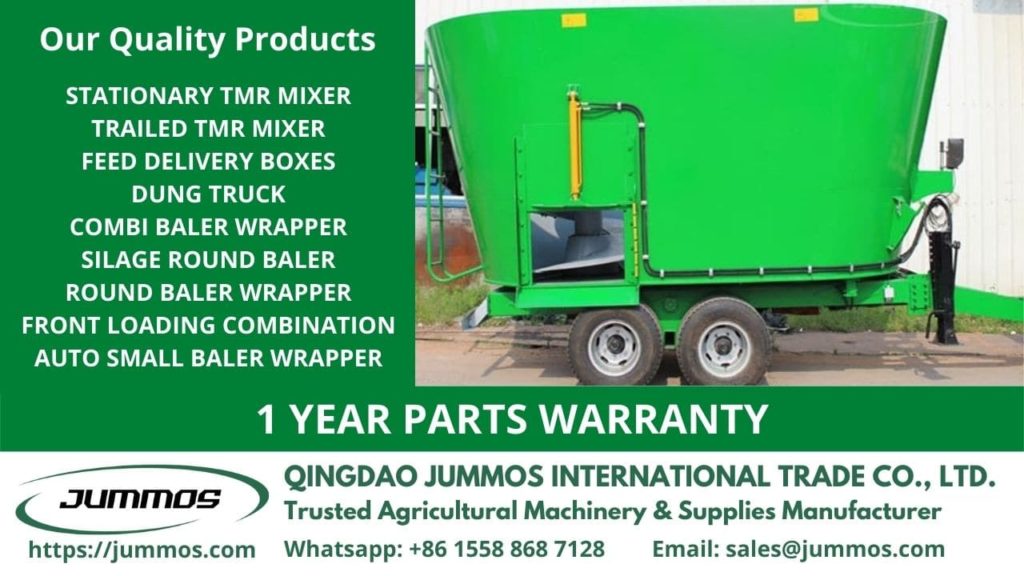
In many industries, a machine is an important support tool. In feed production, the TMR mixer grinder is needed across a whole range of operations, particularly on farms and in small feed mills that prepare their own rations rather than buying them in.
The word “grinder” in the name matters. It points to something a plain mixer does not do, which is reducing raw ingredients to a workable particle size before or during blending. This article looks at what that grinding function actually does, why particle size is worth caring about, and when a farm genuinely needs grinding capability.
A Short Note on Agricultural Machinery
Machinery of this kind sits on a long history of mechanical engineering. Archimedes, working in the third century BC, developed principles of mechanics that still underpin the screw conveyors used in feed equipment today. Much later, the engineer Al-Jazari wrote his Book of Knowledge of Ingenious Mechanical Devices in 1206, documenting mechanisms that influenced machine design for centuries afterwards.
Modern feed machinery descends from that same line of thinking. A TMR mixer grinder is not a complicated idea at heart. It is a screw, a motor, and a well-designed chamber, applied to the specific problem of turning raw feed ingredients into something an animal can digest efficiently.
Grinding and Mixing Are Two Different Jobs
This is the point worth being clear about, because the two are often talked about as if they were the same thing.
Mixing is the blending of ingredients so that every portion of the finished ration has the same composition. The goal is uniformity, so that an animal cannot pick out the parts it likes and leave the rest.
Grinding is the reduction of an ingredient’s particle size, most often applied to grains and other concentrate feedstuffs. The goal here is digestibility. A whole grain kernel has a hard outer shell, and if it passes through the animal intact, the energy inside it is simply lost. Cracking or grinding that kernel opens it up so the digestive system can actually reach the starch.
Forage is a separate case again. Long hay and stemmy material need to be cut to a workable length, and in a TMR mixer that job is done by knives mounted on the augers rather than by a grinder. Our article on TMR mixer knives covers that side in detail.
| Process | Applied To | Purpose |
|---|---|---|
| Grinding | Grain and concentrate feedstuffs | Break the kernel so starch becomes digestible |
| Cutting | Hay, straw, and long forage | Reduce length so the ration blends and cannot be sorted |
| Mixing | All ingredients together | Make every mouthful nutritionally identical |
Why Grain Particle Size Is Worth Getting Right
There is a temptation to assume that finer is always better, since finer means more surface area and faster digestion. In ruminants that assumption can cause real trouble.
Grind grain too coarsely and whole kernels pass through undigested, so you pay for energy the animal never receives. Grind it too finely and the starch ferments very rapidly in the rumen, which drives rumen pH down and raises the risk of acidosis. Cattle also need a certain amount of physical fibre length to keep the rumen mat functioning and to stimulate chewing and saliva production, which buffers the rumen naturally.
So the target is a middle ground: fine enough that the grain is genuinely available to the animal, coarse enough that fermentation does not run away with itself. The right setting depends on the grain, the animals, and the rest of the ration, which is why it is worth discussing with a nutritionist rather than guessing at the mill.
How the Screw Stirrer Works
A mixer grinder used on a farm or in a small feed mill is usually built around a screw stirrer, and the arrangement can be single or double.
Inside the machine there is a pipe with a screw, or auger, running through it. Here it is worth correcting a common misunderstanding: the auger is driven by a motor or by a tractor power take-off. It does not turn on its own. What gravity contributes is the return journey. As the screw spins, it lifts material up through the pipe, and because the upper end of the pipe is open, the feed spills out at the top and falls back down across the rest of the batch. That continuous lifting and falling is what produces an even mix.
A double screw arrangement moves more material and generally mixes it more evenly, which is why capacity and screw count tend to increase together. A single screw suits smaller batches and smaller herds. If you are weighing these up, our guides to the single auger TMR mixer and the multiple auger TMR mixer go into the differences.
Who Needs Grinding Capability?
Not every farm does, and it is worth being honest about that before spending money.
If you buy compound feed already ground and blended, and simply add it to forage, you do not need a grinder. Your requirement is mixing, and a standard TMR mixer covers it.
Grinding capability starts to earn its place when you are buying raw grain and processing it yourself. Farms do this because whole grain is usually cheaper per ton than processed feed, because it stores better before processing, and because it gives control over the ration formula rather than depending on what a supplier offers. For an operation of reasonable size, the saving on ingredient cost can pay for the equipment over time.
The reduction in labour matters as well. Handling, cutting, and blending feed by hand is slow and physically demanding, and it produces inconsistent results. Mechanising that work cuts the labour bill, shortens the daily routine, and delivers a more consistent ration, which is ultimately what the animals respond to.
Kinds of TMR Machines
TMR machines come in several forms, and each suits a different way of working. The horizontal mixer uses augers laid along the base of the chamber. The vertical mixer stands the auger upright, which handles long forage and whole bales more comfortably. A stationary mixer stays in one place at a mixing station, while a trailed mixer is towed behind a tractor so the mixing can move to where it is needed.
All of these are feed-processing machines, and the choice between them comes down to your farm layout, herd size, and how far the feed has to travel. Our overview of the TMR mixer compares the types in more depth.
Mixer Machine Producing Company
As a manufacturer, Jummos has been building agricultural machinery for many years. Our core production covers TMR mixers in various configurations for preparing cattle feed, along with a wide range of other machines that support agricultural and farming businesses, including balers, bale wrappers, feed spreader trucks, and manure cleaning equipment.
The main focus in our company is the customer. We work to ensure good quality machinery, we provide a one-year parts warranty, and we support clients around the world. Colour and capacity can be customized to your requirements, and OEM supply is available for distributors and brand partners. Please feel free to look through our website, and do get in touch if you would like help working out which configuration fits your operation.
Frequently Asked Questions
What is the difference between a TMR mixer and a mixer grinder?
A TMR mixer blends feed ingredients into a uniform ration, and its augers carry knives that cut long forage down to a workable length. A mixer grinder adds particle size reduction for grain and concentrate feedstuffs, breaking the kernel so the starch inside becomes digestible. If you buy feed already processed, a standard mixer is enough. If you buy raw grain and process it on the farm, grinding capability becomes useful.
Does a screw stirrer really work by gravity alone?
No, and this is a common misunderstanding. The screw, or auger, is driven by a motor or a tractor power take-off. Gravity plays a part only in the second half of the cycle: the powered screw lifts material up through the pipe, the feed spills out of the open upper end, and then falls back down over the rest of the batch. That repeated lifting and falling is what creates an even mix, but the lifting itself is powered.
Can grain be ground too finely?
Yes, and it is a real risk in ruminant feeding. Finely ground grain ferments very quickly in the rumen, which pushes rumen pH down and increases the risk of acidosis. Ground too coarsely, on the other hand, and whole kernels pass through the animal undigested, wasting the energy you paid for. The target sits between the two, and the ideal setting depends on the grain type, the animals, and the rest of the ration, so it is worth checking with a nutritionist.
Is a mixer grinder suitable for a small farm?
It can be, and small farms and small feed mills are exactly where these machines are commonly used. The question to ask is whether you are processing raw ingredients yourself. A small farm buying ready-made compound feed does not need grinding capability and is better served by a straightforward mixer. A small farm buying whole grain to save on feed cost may find that a machine which grinds and mixes pays for itself, particularly once the labour saving is counted alongside the ingredient saving.
Reviewed by Sue Su, Marketing Director of Jummos, on August 14, 2026. The processing and particle size guidance was checked against current animal nutrition references to keep the information accurate for farmers.