
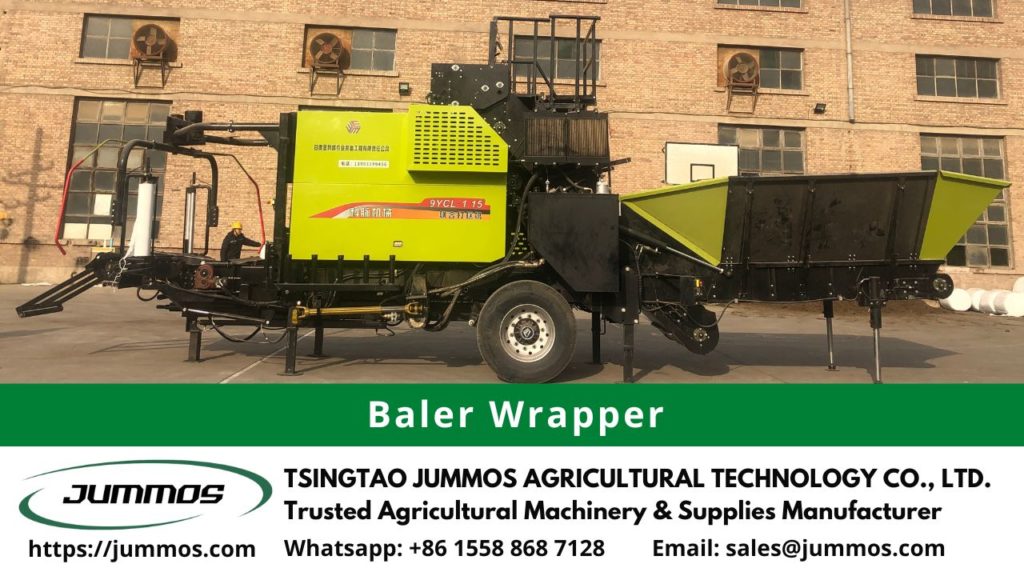
Wrapping bales is an activity that takes quite a lot of time and energy. Today’s modern farms use baler wrappers to help them get the work done on time. This is a long way from how traditional farmers managed. In the past they stored very little animal feed. Forage was gathered from wherever it could be found, and that was the feed for that day. Anything left over went into a warehouse or an open space near the livestock pen.
Once the remaining feed or straw reached bulk quantities, farmers would store it in silos. Today there is simpler technology available, and a baler wrapper will preserve feed for months rather than days. New business opportunities open up too, because farmers who can wrap bales reliably are no longer limited to feeding their own herd. They can sell those bales to others.
Perhaps the forage you rely on nearby is running short. Perhaps feed has been spoiling on you because of weather and poor storage. Even so, you may still be hesitant about buying a baler wrapper, and the hesitation usually comes down to a few practical questions. How much electricity does it take to wrap a batch of 10 to 20 bales? Is the machine actually fast enough to be worth it? What does maintenance involve, and will you need to call a technician every time something goes wrong?
Those are fair questions. Once you understand what a baler wrapper does and how the different types differ, they become much easier to answer.
What Is a Baler Wrapper?
A baler wrapper is a machine that forms forage into bales and seals them in strong plastic film. It handles the job quickly and with very little labour compared with doing it by hand. Most machines are powered by a tractor or an electric motor, and the more advanced ones add remote control and electronic monitoring.
The way it works is straightforward. The machine performs two tasks in the field: it collects and compresses the crop into a solid round or square bale, then wraps that bale in layers of plastic film until it is completely covered. Bales of hay, legumes, corn, or mixed forage then go through fermentation, which is what allows them to keep for weeks or months in storage.
It is worth noting that a baler wrapper is not the same as a plain baler. A baler forms the bale and binds it with net wrap or twine, which holds its shape but does not seal it. A baler wrapper goes the extra step and applies the airtight film. For silage, that second step is not optional.
Round bales and square bales serve the same purpose. Where they differ is in how they stack, store, and transport once they leave the field.
Benefits of Using a Baler Wrapper
You might reasonably wonder whether a machine like this is worth the space it takes up on your farm. That concern applies mainly to the larger models, and there are plenty of compact machines built for small farms. The right choice depends on your budget, your farm layout, and how much forage you actually handle.
So the question becomes what the machine gives you in return. There are three benefits that matter most.
Excluding Oxygen
Oxygen is the enemy of any feed you intend to store. Oxygen trapped inside a bale allows spoilage organisms to grow, which shortens the useful life of the feed considerably. Wrapping with the right machine and the right film seals the bale so that oxygen cannot get in.
What happens next is the whole point of ensiling. With oxygen excluded, aerobic organisms such as moulds and yeasts cannot thrive, and lactic acid bacteria take over instead. These bacteria convert the plant sugars into lactic acid, which lowers the pH of the bale and effectively pickles the forage. That acidity is what preserves the nutrition inside until you open the bale months later.
Protecting Feed from the Weather
Days of heavy rain, or long exposure to direct sunlight, will both degrade silage quality. Many farms have no choice but to store bales outdoors, either because the layout does not allow indoor storage or because the warehouse is already full.
Without proper wrapping, a bale left outside will grow mould after rain, and sunlight will degrade the material inside. A properly wrapped bale, using UV-stabilised film, survives outdoor storage through a full season. This is the benefit farmers notice most immediately, because the difference between a wrapped and unwrapped bale after a wet month is impossible to miss.
Safer, More Stable Storage
Wrapped bales are firm and uniform, which means they stack predictably and stay where you put them. That matters for safety in a yard where bales are handled with loaders.
There is a related point worth understanding, because it is often confused. Spontaneous heating is a genuine hazard, but it applies to dry hay baled at too high a moisture content, where microbial activity generates heat inside the bale and can, in bad cases, lead to fire. That is a moisture management problem at baling time, not something wrapping causes or cures. Wrapped silage is a different process entirely: it is meant to be moist and to ferment. The lesson is simply to bale dry hay dry, and to wrap silage properly, rather than treating the two the same way.
Choosing the Best Baler Wrapper Manufacturer
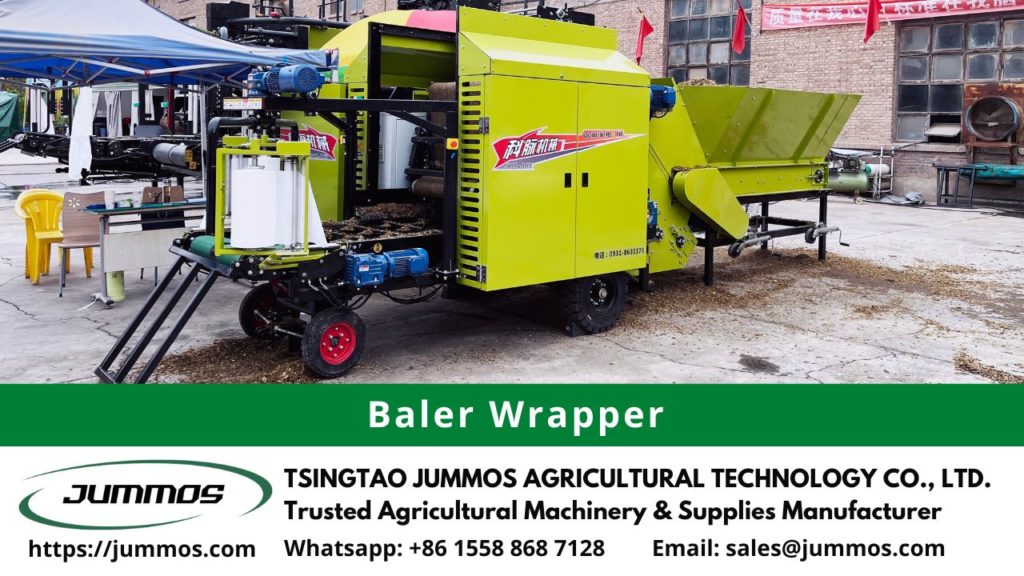
A baler wrapper will preserve surplus crops including corn, alfalfa, and sugar beet tops, along with grass and legume forage. The film used for this is linear low-density polyethylene, or LLDPE, which is chosen for its stretch, its cling, and its ability to hold an airtight seal outdoors. Around 6 to 8 layers of film are applied around the bale by the machine’s wrapping arms, with 6 layers being the general standard and 8 preferred for higher moisture crops or longer outdoor storage.
Machines vary considerably in size and capacity, so it is worth matching the model to the work. Jummos, operating as Tsingtao Jummos Agricultural Technology Co., Ltd., builds several options.
| Machine | Output | Best Suited To |
|---|---|---|
| Round baler wrapper | 40 to 50 bales per hour | Large operations wrapping high volumes with silage film |
| Combination machine | Bales up to 1000 x 850 mm, around 500 kg for corn | Commercial farms wanting large, dense bales |
| Auto small baler wrapper | 60 to 80 bales per hour | Small farms and tight working areas |
Note that the compact machine actually produces more bales per hour than the large one. That is because its bales are much smaller, so throughput in bales does not translate directly into tonnes of forage. When comparing machines, always check bale size alongside the hourly figure, or you will draw the wrong conclusion.
To see the full range with detailed specifications, visit our baler wrapper page, and if you want to understand the consumable side, our guide to silage film explains what to look for in the film itself.
You only need to choose according to the needs of your farm and your business. Contact us to talk through which baler wrapper suits your situation, and we will help you work it out before you commit to anything.
Frequently Asked Questions
What is the difference between a baler and a baler wrapper?
A baler forms the crop into a bale and binds it with net wrap or twine, which holds the shape but does not seal it against air. A baler wrapper does both jobs: it forms the bale and then wraps it in layers of airtight plastic film. For dry hay stored under cover, a plain baler is often enough. For silage, the film seal is essential, because fermentation only works when oxygen is excluded.
How many layers of film should a bale receive?
Six layers is the general standard, and eight layers is preferred for higher moisture crops, for bales stored outdoors, or where bales will be handled and transported frequently. Fewer layers save film in the short term but risk the whole bale, since even small gaps let oxygen in and cause spoilage you will not discover until the bale is opened.
What plastic is used for wrapping bales?
Silage stretch film is made from linear low-density polyethylene, known as LLDPE, usually in a multi-layer co-extruded construction with UV stabilisers added. The UV protection matters because bales frequently sit outdoors for months, and ordinary plastic would break down under sunlight long before the feed is used. Do not confuse this with polypropylene, which is used for baler twine rather than for stretch wrap.
Does a baler wrapper work for square bales as well as round?
Yes, machines are built for both formats. Round and square bales preserve equally well when wrapped properly, and the choice between them usually comes down to handling and storage. Square bales stack more efficiently and use transport space better, while round bales shed water more readily and are common where bales are stored outside. Match the format to how you store and move feed on your own farm.
Reviewed by Sue Su, Marketing Director of Jummos, on September 5, 2026. Film specification and wrapping guidance were checked against current industry references to keep the information accurate for farmers.